Marketing data architecture organizes how data moves through a marketing ecosystem, connecting collection, management, analysis, activation, and distribution. Its central challenge is balancing personalization with privacy, consent, trust, and measurable business value. section 2.3 section 2.5
The architecture has five connected layers:
- Sourcing collects data, while the data foundation organizes and manages it. section 2.3
- Insights and intelligence turns managed data into analysis and usable understanding. section 2.3
- Engagement and activation applies data to personalized marketing experiences and messages. section 2.3
- Media distribution delivers those experiences through websites, apps, social platforms, email, advertising, television, radio, print, and out-of-home channels. section 2.3.5
- Privacy practices belong at every layer: minimize collection, obtain consent, provide transparency and control, limit purpose, and secure data. section 2.3 section 2.5
A privacy-preserving cross-channel campaign
A campaign can centralize targeting criteria in a first-party data solution, activate audiences across multiple channels, and measure results with aggregated or anonymized attribution. Data clean rooms and privacy-enhancing technologies support collaboration without exposing unnecessary personal data. section 2.3.5 section 3.0
Figure 2.2 Marketing data architecture
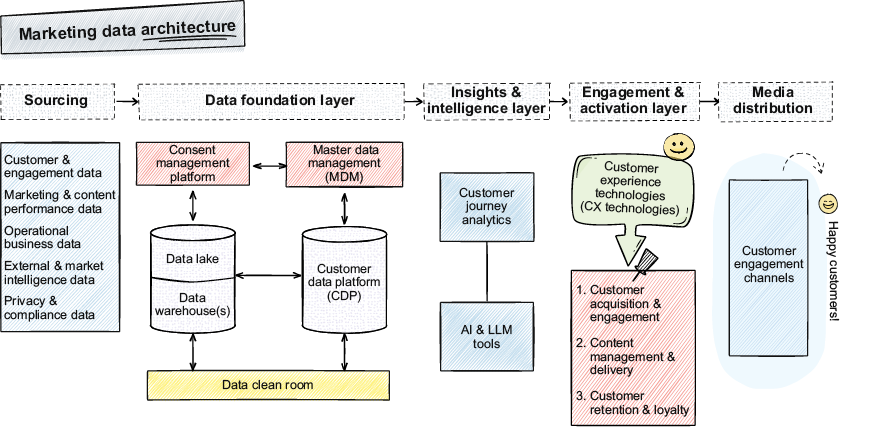
Use the architecture diagram to trace data from sourcing through foundations, intelligence, activation, and media distribution. section 2.3
