A data artifact is an unusual recorded value caused by the data-collection or processing process rather than by the phenomenon being monitored. A failing or stressed sensor may produce an artifact, making it important to distinguish collection errors from genuinely unusual readings. section 1.1.5
Treat artifacts as part of anomaly investigation rather than as automatically meaningful observations:
- Check whether an unusual value is a point anomaly, a contextual anomaly relative to other or previous readings, or a collective anomaly involving a pattern over time. section 1.1.5
- Inspect nulls and their patterns before applying outlier detectors; missing values may reflect sensor failures, processing errors, or nonrandom conditions. section 9.1
- Separate suspected artifacts from statistical outliers, retain indicators of what was removed or missing, and replace nulls according to their likely source before detection. section 9.1
Figure 1.1 Temperature readings from sensor data presented as a time series. The x-axis tracks time in seconds and the y-axis tracks the temperature. There is an unusually high level of fluctuation at 200 seconds and an usually low level at 800 seconds.
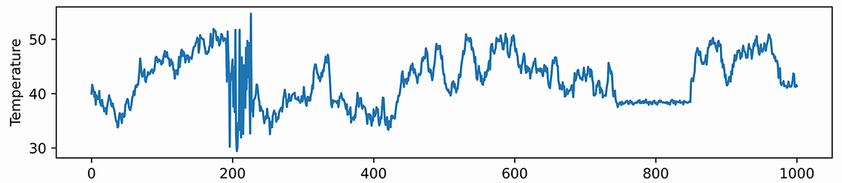
A sensor time series makes collection artifacts visible as abrupt fluctuation or unusually low or high readings at particular times. section 1.1.5
