liveBook · Manning

Data balancing

As explained in Deep Learning with PyTorch, Second Edition

Adjusting class proportions in a dataset to reduce skew and make learning less biased toward a dominant class.

Data balancing adjusts class proportions so a classifier does not favor a dominant class. This matters when heavily skewed negative samples let a model achieve high accuracy by predicting everything as negative. section 14.0

In the lung nodule classification workflow, balancing is treated as a training improvement alongside augmentation. The changes target the dataset implementation and are evaluated through performance metrics. section 14.1

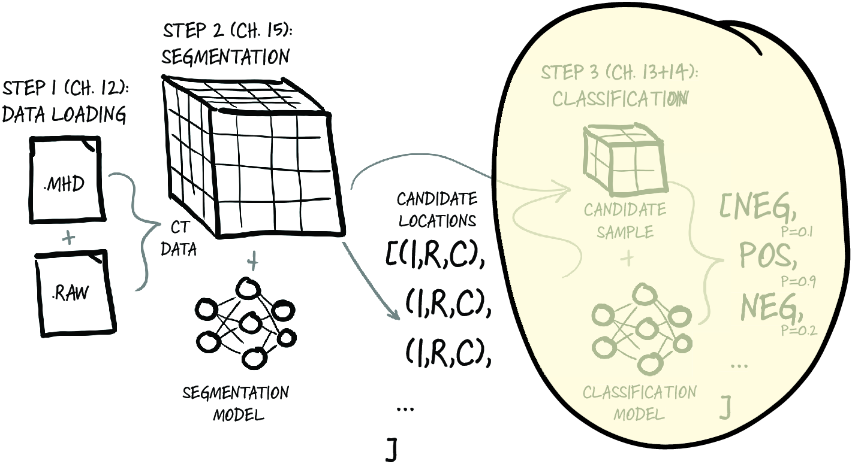
Figure 14.1 Our end-to-end lung cancer detection project, with a focus on this chapter’s topic: step 3, classification.
figure

Places balancing within the classification step of the end-to-end lung cancer detection project. section 14.0

How Deep Learning with PyTorch, Second Edition covers it

How deep it goes
Positions balancing as a LunaDataset change to improve training, but does not detail its procedure.
Examples
Uses lung nodule classification with heavily negative-skewed samples as its motivating example.
What it assumes
Assumes a working classification-training workflow and motivates balancing through misleading overall accuracy.
What you can do after
Apply it by modifying the dataset and checking whether performance metrics improve during training.
How it connects
Connects balancing with classification, augmentation, precision, recall, and F1 score.

Related concepts

This explainer was generated by Manning's knowledge graph from the text of Deep Learning with PyTorch, Second Edition. The section links point to the parts of the book it draws on.