liveBook · Manning

Data center network

As explained in Acing the CCNA Exam: Volume 2 Advanced Networking and Security

A data center is a facility or dedicated space that centralizes an organization's servers, storage systems, and network infrastructure.

A data center network supports a facility or dedicated space that centralizes servers, storage systems, and the network infrastructure connecting them. Large data centers may contain thousands of servers, storage devices, and network devices. section 15.3

Traditional data center networks use a three-tier design: access, aggregation, and core. A server group with its access and aggregation switches forms a pod. Virtual servers and distributed applications increased east–west traffic between servers, while north–south traffic enters or exits through the WAN or internet. Multiple-layer paths can create bottlenecks and unpredictable server-to-server latency. section 15.3.1

Figure 15.8 A three-tier data center LAN consisting of an access layer, aggregation layer, and core layer
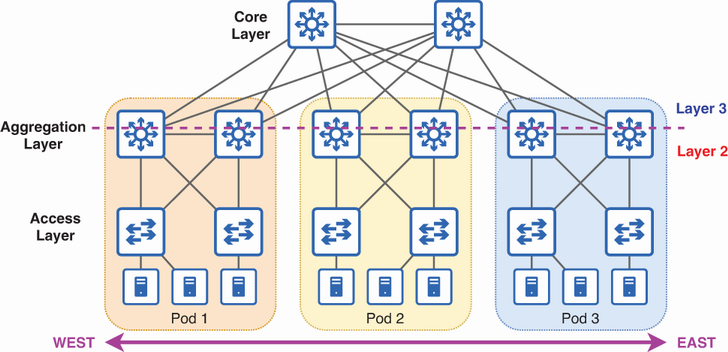
Use the three-tier topology to identify access, aggregation, and core layers and understand how server traffic traverses the design. section 15.3.1

Spine-leaf architecture addresses modern east–west traffic with two layers: servers connect to leaf switches, every leaf connects to every spine, and leaf-to-leaf and spine-to-spine connections are absent. Leaf switches serving external networks may be called border leaves. section 15.5

How Acing the CCNA Exam: Volume 2 Advanced Networking and Security covers it

How deep it goes
Defines facilities, pods, traffic types, and topology relationships, then compares traditional three-tier limitations with spine-leaf structure.
Examples
Uses server pods, server-to-server traffic between pods, and a three-tier topology containing access, aggregation, and core layers.
What it assumes
Assumes general network architecture familiarity while framing data centers within broader LAN topology and design principles.
What you can do after
Evaluate data center topologies by identifying traffic direction, pod structure, bottlenecks, and spine-leaf connectivity.
How it connects
Links data center networks to campus LANs, three-tier architecture, spine-leaf architecture, virtual servers, distributed applications, and east–west traffic.

Related concepts

This explainer was generated by Manning's knowledge graph from the text of Acing the CCNA Exam: Volume 2 Advanced Networking and Security. The section links point to the parts of the book it draws on.