The data-centric paradigm improves machine-learning systems primarily through data engineering: increasing training-data quality and quantity instead of concentrating only on model architecture or hyperparameter tuning. It treats faulty data as a direct cause of faulty predictions and can reduce the need for model engineering in high-complexity models. section 1.2 section 5.3
A practical data-centric workflow emphasizes:
- Improve the training corpus before attempting further model changes, addressing both coverage and data quality. section 1.2
- Use natural-language task formulation and prompt engineering when capable LLMs make extensive model engineering unnecessary. section 5.3
- Validate outputs carefully: improved data does not eliminate hallucinations or unsupported reasoning when relevant information is absent from training data. section 5.3
Figure 5.3 Mental model of transforming textual data into structured knowledge: NER and RE using an LLM
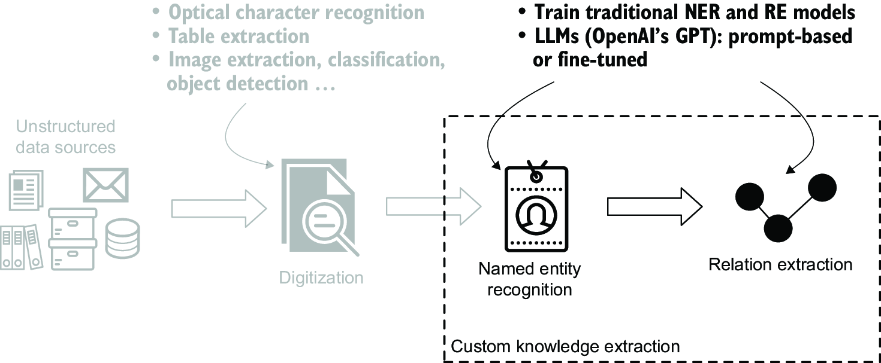
Use the mental model to connect data-centric preparation with extracting named entities, relations, and properties from unstructured text into structured knowledge. section 5.3
