Data locality means focusing each computation on nearby values instead of combining every value with every other value. For images, nearby pixels are usually more useful for recognizing local patterns than distant pixels, so convolutions emphasize neighborhoods and set weights beyond a chosen distance to zero. section 8.1
Convolutions preserve locality while using fewer parameters than fully connected layers. Small kernels such as 3 × 3 or 5 × 5 examine limited neighborhoods; stacking convolutions and downsampling then lets the network combine information across progressively larger portions of an image. section 8.1 section 8.2.3
From local patterns to larger structures
A small kernel can detect part of a shape, while successive convolutions and max pooling combine those local detections into larger structures. In a birds-versus-airplanes classifier, this helps recognize objects whose parts span several pixels without using one large kernel over the entire image. section 8.2.3
Locality in convolutional networks leads to these related effects:
- Convolution restricts each weighted sum to nearby pixels rather than the whole image. section 8.1
- Pooling reduces spatial dimensions, commonly by taking maximum or average values over local regions. section 8.2.3
- Translation invariance complements locality by helping recognize patterns despite their position in the image. section 8.1
Figure 8.10 More convolutions by hand, showing the effect of stacking convolutions and downsampling: a large cross is highlighted using two small, cross-shaped kernels and max pooling
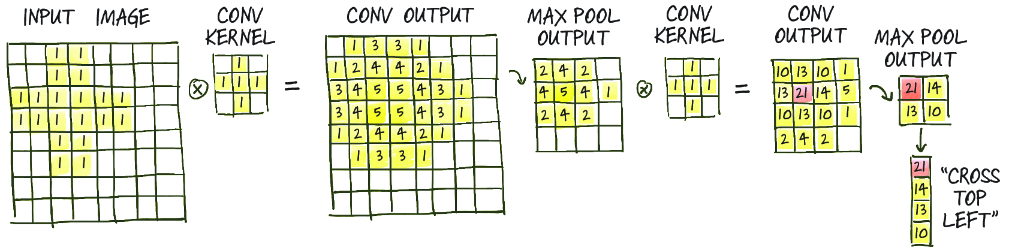
Trace how two small kernels and max pooling combine local evidence to highlight a larger cross. section 8.2.3



