State persistence keeps a system’s goal-directed operation coherent across multiple steps or interactions. It separates an active agent from a reactive assistant that answers once and stops. In an agentic system, the plan and state may be short-lived inside one loop or stored externally so work can continue across longer horizons. section 1.1 section 9.1.2
A practical persistence design makes the following elements explicit:
- Goal: the outcome that coordinates multiple short-horizon tasks. section 9.1.2
- Plan: the ordered or revisable outline that the agent rereads while working. section 5.1.3
- State: progress, intermediate results, observations, and other information needed for the next decision. section 9.1.2 section 5.1.3
- Decision and tool: programmatic mechanisms that determine the next action and invoke the agent or another capability. section 9.1.2
Revising a plan after new information
An itinerary first schedules an Exploratorium visit and startup tours. After learning that the museum is closed and no startups are available, the plan is revised rather than restarted from the original goal. The updated itinerary demonstrates why observations, progress, and planned actions must remain available to later steps. section 5.1.3
Figure 9.2 Comparison of short- and long-horizon goals. You can see how this process requires promoting the single-agent internal loop to the level-2 external task-based agentic loop.
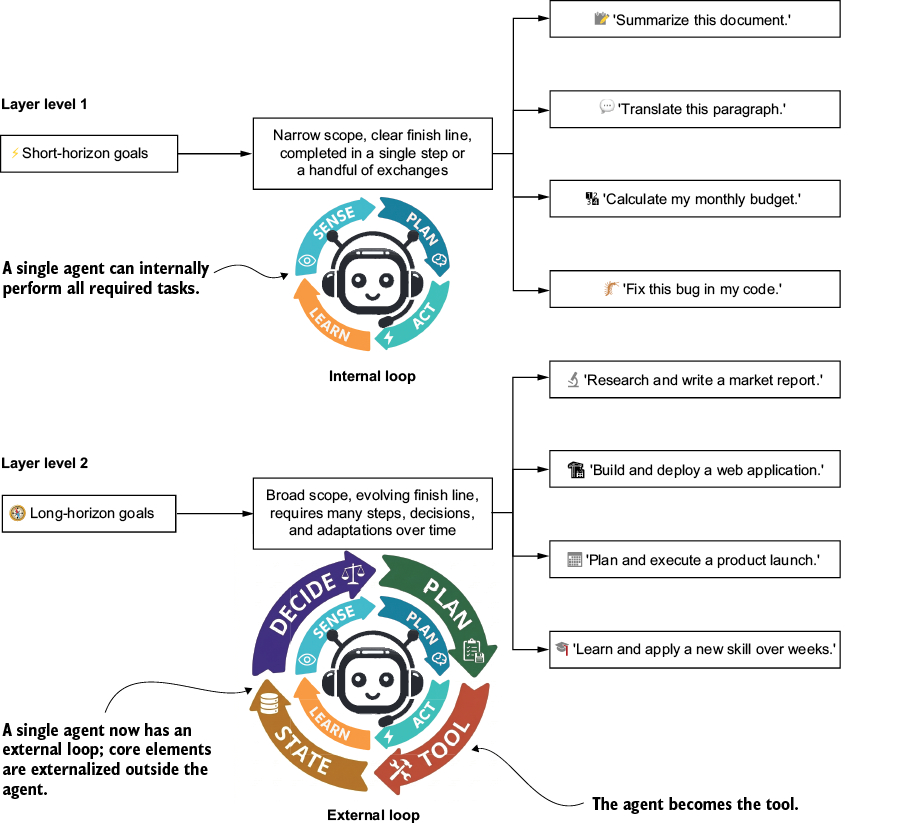
Use the comparison of short- and long-horizon goals to see when an internal agent loop must become an external task-based loop. section 9.1.2
Persistence is also a storage concern. Learning examples may keep memories in process memory or local stores that disappear when the process stops; production systems require durable storage alongside access control, observability, eviction policies, and retrieval evaluation. Hybrid memory can combine semantic search with graph search, but the storage backend, memory extraction, and retrieval logic remain separate engineering responsibilities. section 6.4.3






