liveBook · Manning

Database management tool

As explained in Building Web APIs with ASP.NET Core

A database management system is software that stores, organizes, retrieves, and manages access to structured data.

A database management system (DBMS) is software for creating, organizing, retrieving, and managing large sets of structured data. It replaces temporary or fabricated application data with a persistent source that a web API can query and update. section 4.1 section 4.0

In a service-oriented architecture, the web API retrieves data from the DBMS and makes it available to web apps, mobile apps, administrative sites, cloud services, and machine-learning systems. section 1.1.1

A DBMS supports practical application and infrastructure decisions through:

  • Efficient access, categorization, normalization, and versatile use of structured information. section 4.1
  • ACID transactions and security benefits related to confidentiality, integrity, and availability. section 4.1
  • Deployment choices including an on-premise database server or a cloud-hosted service such as Microsoft Azure. section 4.0

Board-game API data

A board-game API can replace its static sample-data procedure with a DBMS, then use Entity Framework Core to retrieve and persist relational data through an object-relational mapping layer. section 4.0
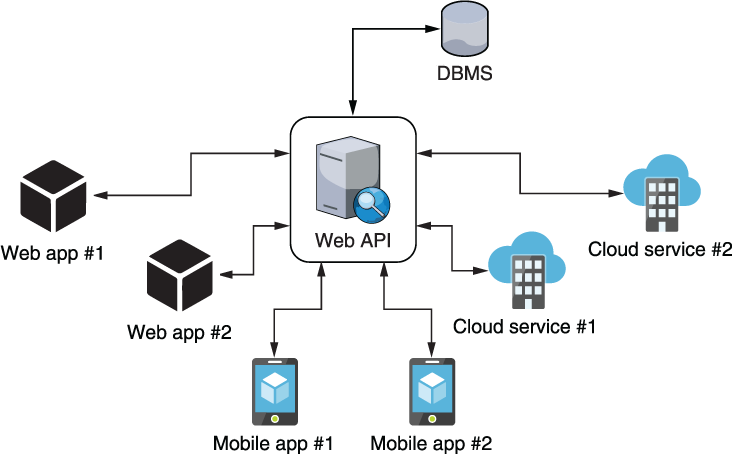
Figure 1.2 The role of a web API in a typical SOA-based environment
01-02

Use the architecture figure to trace how a DBMS supplies data through a web API to multiple client and cloud services. section 1.1.1


How Building Web APIs with ASP.NET Core covers it

How deep it goes
Defines core DBMS properties and compares deployment options, but stops short of detailed database administration or transaction implementation.
Examples
Uses board-game data, static sample-data replacement, web API clients, on-premise servers, and cloud-hosted database services.
What it assumes
Assumes awareness of basic database advantages while introducing DBMS concepts, deployment alternatives, and API integration needs.
What you can do after
Evaluate and configure a DBMS choice for a web API, then connect it through Entity Framework Core.
How it connects
Connects DBMSs with web APIs, service-oriented architecture, Entity Framework Core, object-relational mapping, database schemas, and data models.

Also explained in

Compare how 2 books explain database management tool →

Related concepts

This explainer was generated by Manning's knowledge graph from the text of Building Web APIs with ASP.NET Core. The section links point to the parts of the book it draws on.