The de Casteljau algorithm constructs and subdivides a Bézier curve through repeated interpolation. Rather than treating the curve as an opaque line, it works from the curve’s defining points: two endpoints and two control points. Subdivision produces smaller Bézier pieces that together follow the original curve. section 2.2
This makes a curved line easier to handle in computerized drawing. Moving the control points changes the curve, while subdivision lets a complicated form be built from manageable pieces. Joined pieces can form paths, such as the several paths used to draw an ampersand. section 2.2
Try one subdivision
Print or trace a Bézier curve and divide it into two using de Casteljau’s procedure. Use a pencil and ruler, then repeat the experiment in a drawing program to compare the physical construction with interactive manipulation. section 2.4
Figure 2.8 De Casteljau curve subdivision
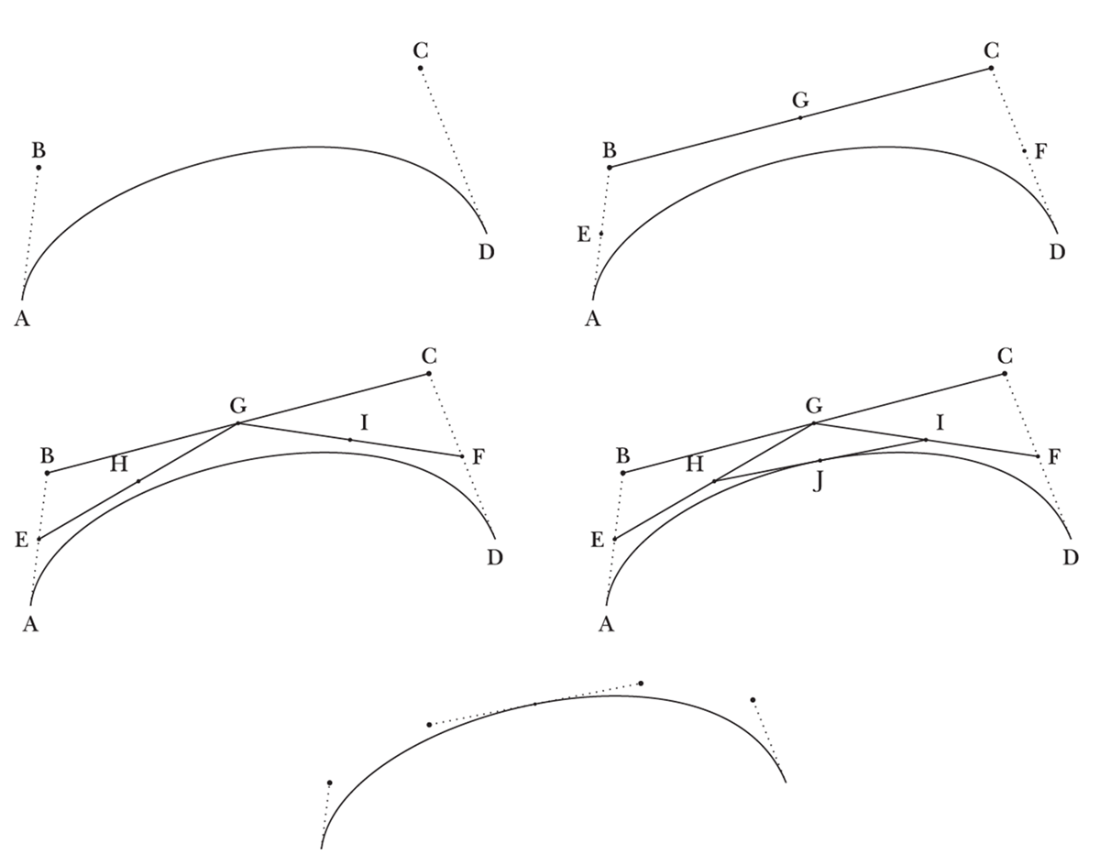
Use the curve-subdivision figure to follow how the original Bézier curve becomes two connected pieces. section 2.2