A deadlock occurs when concurrent executions block indefinitely while waiting for one another to release exclusive resources. It can appear only after a program has run normally for some time, making it difficult to identify and debug. section 11.0
Two locks, opposite order
Two goroutines can deadlock when each holds one mutex and waits for the other: red acquires lock1 then lock2, while blue acquires lock2 then lock1. Output stops when each reaches its second lock request. Because execution order is nondeterministic, the same program may not deadlock on every run; delays between lock acquisitions increase the chance. section 11.1
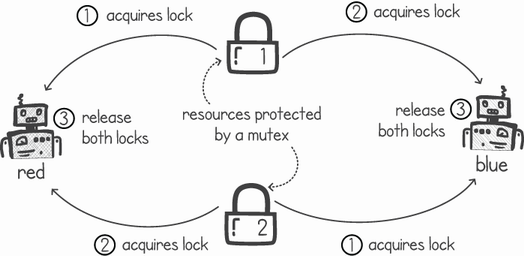
Trace each goroutine’s held lock and requested lock. A circular wait explains why neither execution can continue. section 11.1
The same pattern can halt a ledger: transfers lock a source account and then a target account, so several goroutines may form a cycle of held and requested account locks. That cycle can also block unrelated work that needs one of the locked accounts. section 11.1.2
Address deadlocks through three broad approaches:
- Detect them after they occur. section 11.2
- Avoid unsafe allocations by scheduling resource requests so every execution can still reach completion. section 11.2.2
- Prevent deadlock scenarios through program design, such as coordinating acquisition of all required accounts before a transfer proceeds. section 11.2 section 11.2.2
A safe state has some schedule in which all executions can complete even if each requests its maximum resources. The banker’s algorithm decides whether granting a request preserves that safety, requiring known maximum requests, current holdings, and available resources. section 11.2.2
Arbitrating ledger transfers
An arbitrator tracks whether accounts are in use. A goroutine waits on a condition variable until every requested account is free, marks them all in use together, performs the transfer, then frees them and broadcasts to waiting goroutines. This prevents a transfer from holding one account while waiting for another. section 11.2.2
Practice by changing code that locks multiple player records concurrently, or by using select to avoid circular waits between channel operations. section 11.4