Decentralized governance distributes responsibility for data standards and controls across business domains. Teams own high-quality data products, while shared rules keep data standardized, documented, secure, and interoperable. section 18.1.2 section 18.6
The model addresses a common failure of centralized data management: a central team collects data it cannot accurately assess, while domain teams lose ownership of its meaning and quality. Instead, domains publish, consume, and modify their data through self-service infrastructure while following common protection and governance rules. section 18.1.2 section 18.1.3
A workable division of responsibilities looks like this:
- Business units define and maintain data products that satisfy the needs of other departments or external partners. section 18.1.2
- Shared governance requires data to be described, documented, standardized, interoperable, and compliant with security and protection rules. section 18.1.2
- The central data team provides technical support, platform capabilities, best practices, templates, and help with significant schema changes rather than managing every pipeline. section 18.1.3 section 18.6
Schema change across domains
When a domain changes a data structure, it remains responsible for its product, while the central data team helps produce a clean schema evolution and preserve compatibility across systems. This keeps local ownership without abandoning organization-wide interoperability. section 18.1.3
Figure 18.1 The core principles of a data mesh
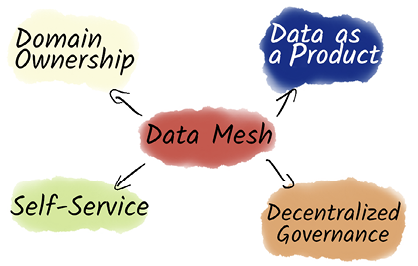
Use the data-mesh principles diagram to relate decentralized governance to domain ownership, data as a product, and self-service data infrastructure. section 18.1.2
