A decision node represents a yes-or-no question in a decision tree. Its two branches correspond to the answers and lead to another decision node or a leaf, where the tree’s decision is made. The topmost decision node is the root; a tree with just one decision node and two leaves is a decision stump. section 9.0
Choosing whether to wear a jacket
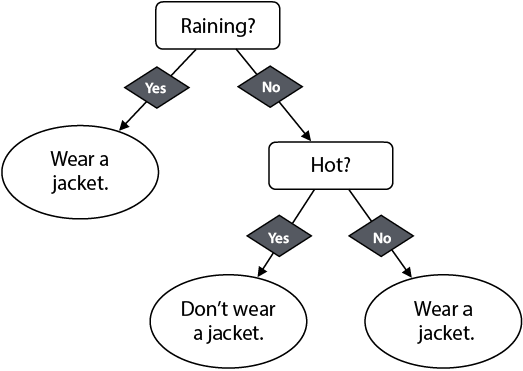
Ask whether it is raining. If yes, wear a jacket; if no, ask whether it is hot or cold, then decide. Each question is a decision node, and following the matching branches carries you through the tree. section 9.0
When building a classifier, a decision node splits the data using a feature. For example, splitting app users by age can create a node; a later split by platform can divide a mixed group further. section 9.2
Figure 9.1 A decision tree used to decide whether we want to wear a jacket or not on a given day. We make the decision by traversing the tree down and taking the branch corresponding to each correct answer.
Follow the branches in the jacket example to see how questions guide a decision through a tree. section 9.0


