liveBook · Manning

Decision problem

As explained in Optimization Algorithms: AI techniques for design, planning, and control problems

A computational problem whose answer is whether an input satisfies a specified property, typically expressed as yes or no.

A decision problem asks whether an input satisfies a specified property or condition. Its answer is binary: yes or no, or true or false. Decision problems provide a foundation for studying algorithmic complexity. section 2.1.1

Turning optimization into a decision question

A routing problem can ask whether a feasible route exists that is optimal or near-optimal under a chosen objective. In a traveling-salesperson problem, the input size may be the number of cities; the decision version asks whether a route meeting the required condition exists. section 2.1.1

Decision problems support complexity classifications:

  • Problems solvable in polynomial time are called tractable. section 2.1.1
  • Common classes include P, NP, NP-complete, and NP-hard. section 2.1.1
Problem classes based on hardness and completeness. Problems can be categorized into NP-hard, NP-complete, NP, or P.
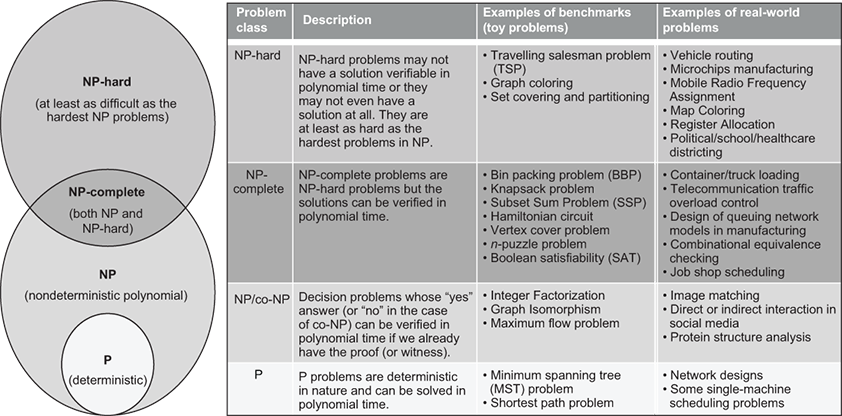
Compare problem classes by hardness and completeness. section 2.1.1
How Optimization Algorithms: AI techniques for design, planning, and control problems covers it

How deep it goes
Defines binary answers and sketches optimization reformulation, then stops short of detailed complexity-class criteria.
Examples
Uses traveling-salesperson routing, vehicle routing, delivery scheduling, and problem-class diagrams as concrete examples.
What you can do after
Evaluate optimization tasks by expressing whether a feasible optimal or near-optimal solution exists.
How it connects
Connects decision problems with optimization problems, algorithmic complexity, polynomial time, and the traveling-salesperson problem.

This explainer was generated by Manning's knowledge graph from the text of Optimization Algorithms: AI techniques for design, planning, and control problems. The section links point to the parts of the book it draws on.