liveBook · Manning

Decision variable

As explained in Applied Reinforcement Learning

A decision variable is a quantity whose value is chosen by an optimization model to represent an available decision.

A decision variable represents a choice an optimization model is meant to make. Unlike an external input, such as a material price, its value is selected to improve the objective while respecting constraints. section 1.3

Bakery production

A bakery can let x₁ represent the number of chocolate cakes to make and x₂ the number of vanilla cakes. These choices are evaluated against labor and flour limits to maximize profit. section 1.6.1

Decision variables also describe operational choices such as how much of each product to reorder or what to produce, when, and in what quantity. section 1.4

Figure 1.6 Linear programming formulation of bakery shop problem.
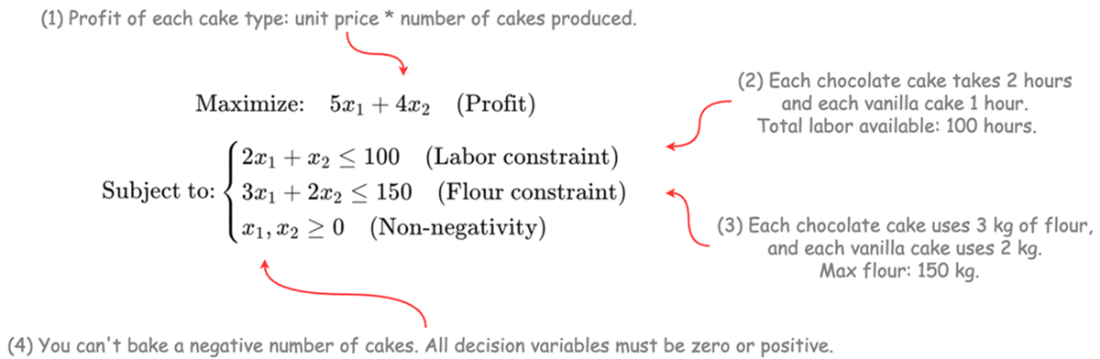
The bakery formulation connects its production choices to the objective and resource constraints. section 1.6.1


How Applied Reinforcement Learning covers it

How deep it goes
Defines choices and illustrates them in a bakery formulation, without detailing how to solve the resulting model.
Examples
Uses cake production quantities, retail reorder quantities, and manufacturing production choices as examples.
What you can do after
Build a basic optimization formulation by representing available choices as variables alongside objectives and constraints.
How it connects
Connects decision variables to objective functions, constraints, operations research, and linear programming.

Also explained in

Compare how 3 books explain decision variable →

Related concepts

This explainer was generated by Manning's knowledge graph from the text of Applied Reinforcement Learning. The section links point to the parts of the book it draws on.
