Decomposability is the property of a model being separable into components that represent smaller causal or domain relationships. Unlike a neural network whose hidden-layer weights are mutually dependent, a causal model can mirror how events unfold: an ad impression drives engagement, which drives purchase. section 1.3.3
Decomposable models support practical workflows:
- Test and validate components independently. section 1.3.3
- Execute components separately for efficient cloud or edge deployment. section 1.3.3
- Retrain only components affected by newly available data. section 1.3.3
- Reuse components in models addressing related problems and optimize them separately. section 1.3.3
Figure 1.2 A model that captures how ad impressions drive engagement, which in turn drives purchases. This model decomposes into {ad impression, engagement} and {engagement, purchase}.
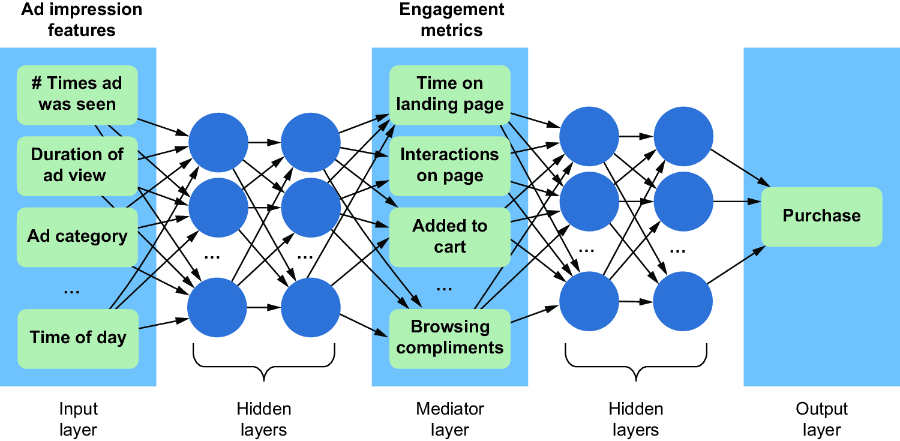
The model separates into {ad impression, engagement} and {engagement, purchase}, making the domain’s causal structure explicit. section 1.3.3
