Deductive reasoning starts with a general statement or hypothesis and derives a specific logical conclusion. If its premises are assumed true, the conclusion follows necessarily. “All men are mortal; Alessandro is a man; therefore, Alessandro is mortal” illustrates the pattern. Unlike inductive reasoning, deduction does not generalize from observations. section 2.4
A deductive reasoning pipeline typically:
- Stores domain facts, rules, costs, outcomes, and relationships in a knowledge base. section 2.5.1
- Transforms source data into logical statements that can guide decisions. section 2.5.1
- Applies rules to relevant knowledge-base segments. section 2.5.1
- Produces an action or recommendation when the encoded premises support one. section 2.5.1
Medical diagnosis
A virtual doctor can use a knowledge base containing disease–symptom relationships, possible tests and treatments, their costs and outcomes, and patient preferences. With complete and accurate data, deduction can infer an optimal sequence of diagnostic actions. Incomplete records or nonspecific symptoms weaken this approach because the required premises may be absent. section 2.5.1
Pure deduction depends on a highly complete, accurate knowledge base, which is rarely available. In hybrid systems, an LLM can interpret ambiguous inputs and weigh multiple possibilities probabilistically, while a knowledge-graph reasoning engine supplies structured rules and knowledge. section 2.5.1 section 2.5.3
Figure 2.11 The deductive reasoner. The knowledge base is created by transforming data sources. The deductive reasoner uses logical statements applied to segments of the knowledge base to act or to provide suggestions.
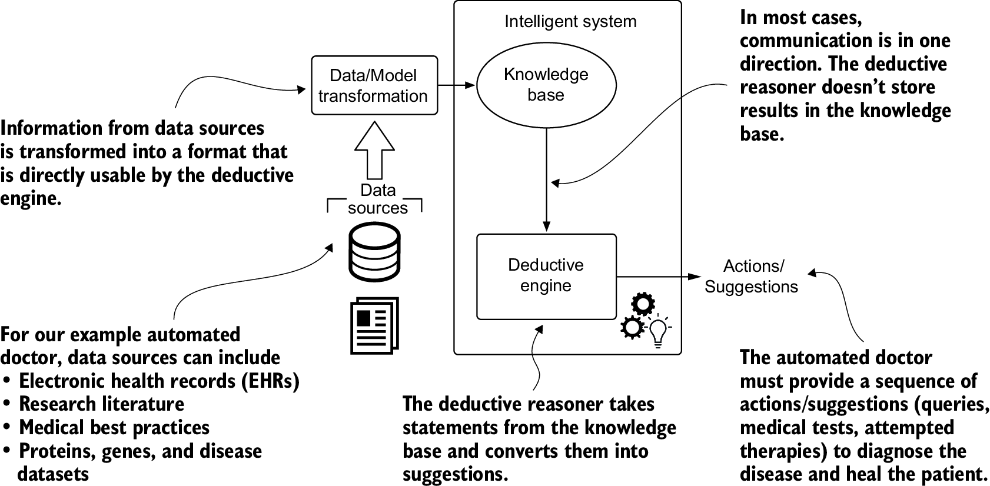
Trace how transformed data becomes logical statements, how a deductive reasoner applies them, and how the system produces actions or suggestions. section 2.5.1
