DeepSeek-R1-Zero tests whether a capable base model can develop reasoning behavior through reinforcement learning without supervised chain-of-thought data. Starting from DeepSeek-V3-Base, it receives rewards for solving verifiable reasoning tasks rather than imitating human-written solution traces. section 7.6
The training pressure changes response behavior: difficult problems receive longer attempts, allowing the model to try approaches, inspect intermediate results, detect errors, and revise. The reported “aha moment” illustrates explicit strategy correction, while longer responses matter only when they support better solutions. section 7.6 section 7.13
Interpret the result with these boundaries:
- Treat <think> as a formatting convention separating reasoning-style text from the final answer, not as a Python construct or interpreter feature. section 7.6
- Expect rough edges: R1-Zero can produce poor readability and language mixing, motivating later refinement. section 7.6
- Distinguish R1-Zero from DeepSeek-R1: R1-Zero is the pure RL experiment, whereas R1 adds supervised stages, filtering, mixed instruction data, and final preference optimization. section 7.7 section 7.7.1
- Read the transition from R1-Zero to R1 as data flow: filtered outputs become training data rather than transferring R1-Zero parameters directly. section 7.7.1
A self-correction trace
A reasoning response begins with one approach, notices that the path is flawed, and changes strategy before producing the answer. This behavior exemplifies the reported “aha moment”; the visible reasoning region is marked with <think>. section 7.6
Figure 7.14 DeepSeek-R1 training pipeline, adapted from Guo et al., DeepSeek-R1, Figure 2. The flow from R1-Zero into R1 represents filtered training data, not direct parameter transfer.
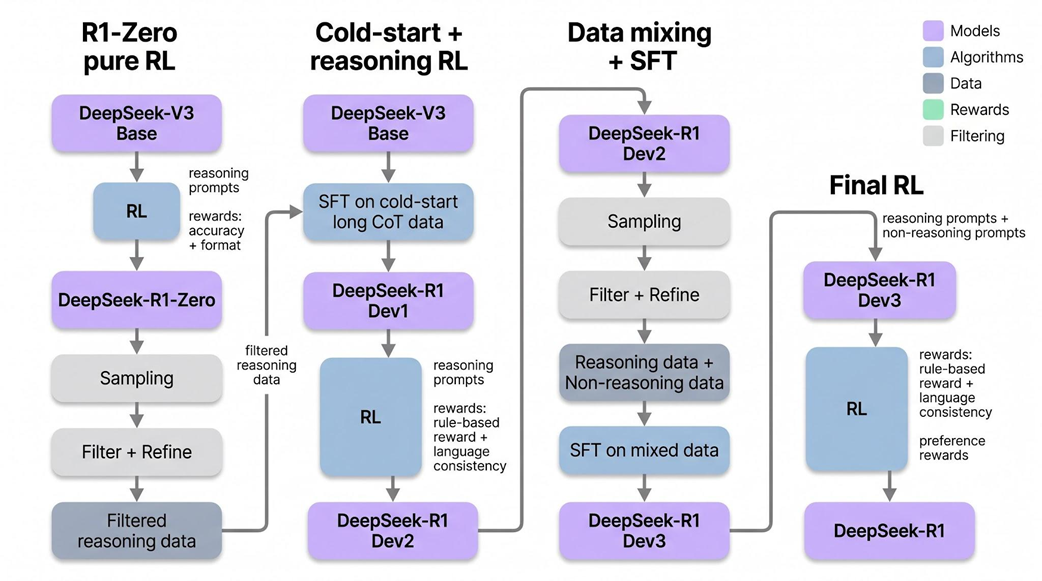
Use the pipeline diagram to trace how R1-Zero outputs are sampled, filtered, and converted into training data for the more usable R1 system. section 7.7.1
