The Cisco IOS default-information originate command makes an OSPF router advertise its default route to OSPF neighbors. The router must already have a default route in its routing table. section 18.2.4
Key points:
- Configure a static default route first, then enter the command under router OSPF configuration. section 18.2.4
- The advertising router becomes an autonomous system boundary router (ASBR). section 18.2.4 section 18.5
- The always keyword advertises a default route without a local default route, but its use is beyond the CCNA exam scope. section 18.2.4
R1 advertises a default route
R1(config)# ip route 0.0.0.0 0.0.0.0 203.0.113.2 R1(config)# router ospf 1 R1(config-router)# default-information originate R2# show ip route ospf O*E2 0.0.0.0/0 [110/1] via 10.0.0.1 R2 learns the default route through OSPF.
Figure 18.8 R1 functions as an ASBR, advertising a default route into the OSPF AS. After configuring a default route, use default-information originate to advertise the route to other routers in the OSPF AS.
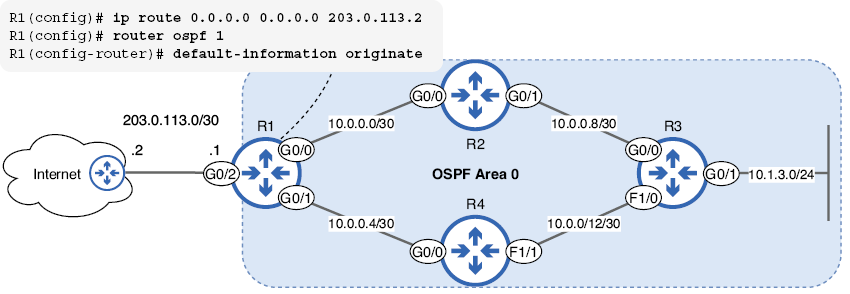
Trace how an ISP-connected R1 advertises a default route into the OSPF area for R2, R3, and R4. section 18.2.4
