In residual networks, degradation occurs when increasing depth makes accuracy saturate and then decline. A 56-layer network can have higher training and test error than a 20-layer network on CIFAR-10, despite having greater expressive power. Higher training error distinguishes degradation from ordinary overfitting. section 11.2.3
A deeper network should at least match a shallower one by preserving the original layers and learning the identity function in the added layers. In practice, the added layers struggle to learn identity mappings. For a target function h(x), learning the residual g(x) = h(x) − x can be simpler than learning h(x) directly. section 11.2.3
The degradation diagnosis motivates residual architecture:
- Rejects overfitting and unhealthy gradients as sufficient explanations for the observed result. section 11.2.3
- Uses shortcut or skip connections so layers can more easily preserve an identity mapping. section 11.2.3
Figure 11.9 Training error (left) and test error (right) on the CIFAR-10 data set with 20-layer and 56-layer networks. (Source: “Deep residual learning for image recognition”; https://arxiv.org/pdf/1512.03385.pdf.)
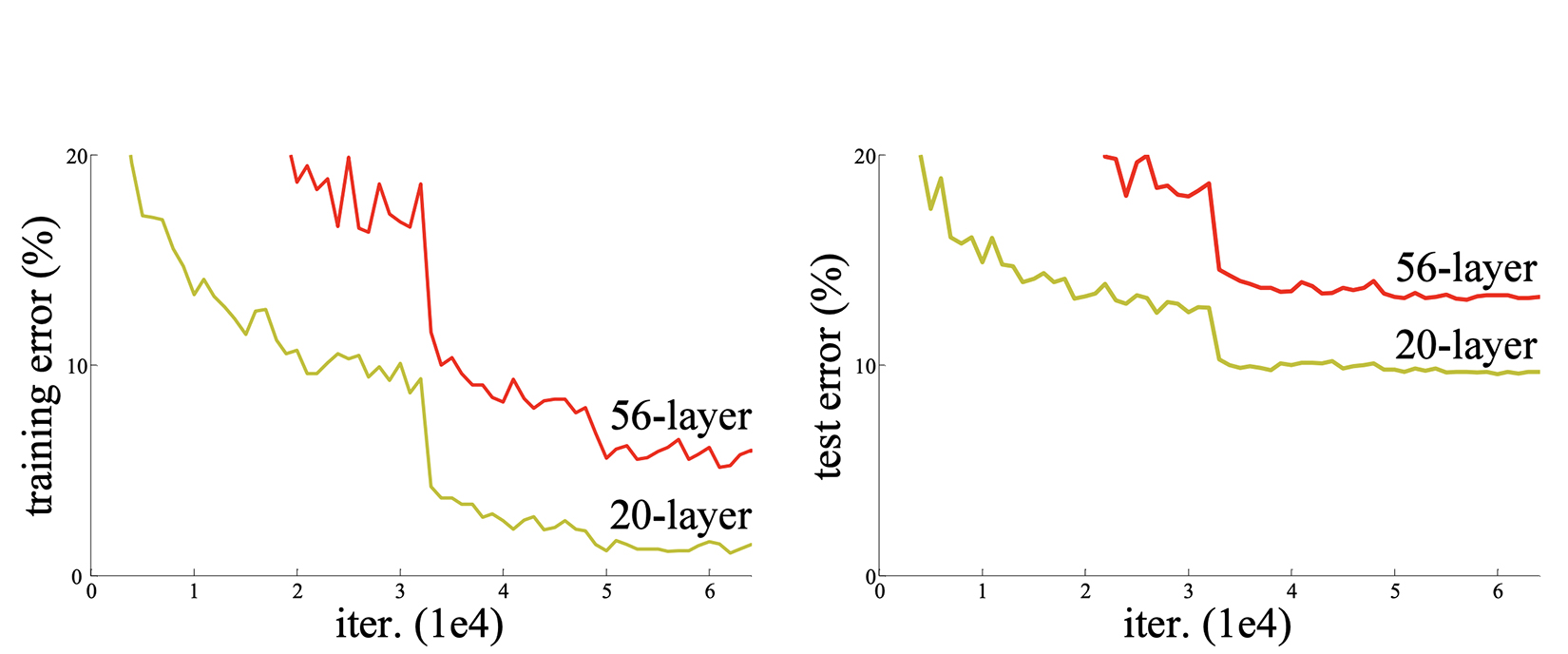
Compare training and test error curves for 20-layer and 56-layer networks on CIFAR-10. section 11.2.3




