A delivery guarantee defines whether messages are sent, retained, acknowledged, and processed despite failures, retries, lost acknowledgments, and consumer restarts. In asynchronous systems, proving where a message disappeared is difficult, so guarantees depend on explicit producer, broker, and consumer behavior. section 7.4 section 5.1.1
Common failure paths include:
- A producer never sends the message, or fails to handle a missing acknowledgment after the broker rejects or loses the write. section 7.4
- A leader acknowledges a message before failing to replicate it to followers, creating potential data loss. section 7.4
- Retention can delete a message before consumption, while a consumer can reread processed data after failing before committing its offset. section 7.4
- A lost acknowledgment can cause a producer to resend an already written batch, creating duplicates; retries can also raise ordering concerns. section 7.4 section 3.2.5
Customer 360 producer configuration
A producer can strengthen delivery behavior with enable.idempotence=true, acks=all, appropriate retries, and a suitable max.inflight.requests.per.connection value. The same architecture uses entity identifiers as partitioning keys and unique client identifiers for monitoring. These settings support ordered, duplicate-free batch delivery under the stated criteria, while acks=all provides assurance against broker-side data loss. section 3.2.5
Figure 5.2 Using compacted topics in Kafka: you always retain the latest version of each event, allowing Kafka to act as a source of truth.
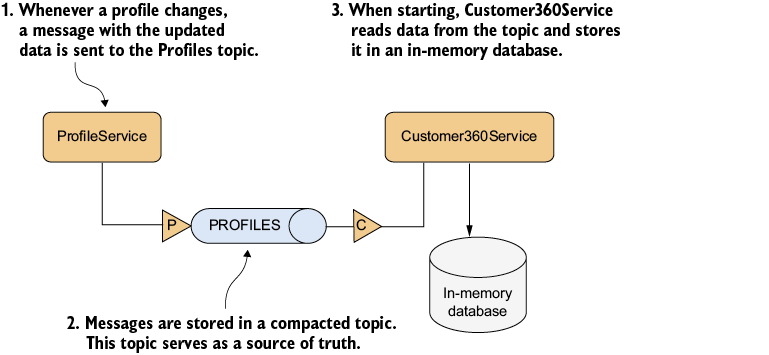
Compacted topics illustrate the retention dimension of delivery guarantees by preserving the latest version of each event and allowing Kafka to act as a source of truth. section 5.1.1
