Delivery risk is the possibility that delaying an unresolved decision will block progress, force workarounds, increase costs, or create unsafe shortcuts. It rises when waiting replaces preserved flexibility with pressure. section 4.4
Assess delivery risk alongside uncertainty and reversibility:
- Delay when uncertainty remains high, the cost of waiting is low, and learning is likely to improve the decision. section 4.4
- Decide when uncertainty is no longer shrinking while delivery risk continues to increase. section 4.4
- When reversal is expensive, preserve options with a seam, prototype, ADR, or compatibility strategy. section 4.4
- Treat blocked delivery as avoided decision-making rather than responsible delay. section 4.4
Figure 4.2 Architectural decisions are most effective when made at the last responsible moment: late enough to preserve flexibility, but early enough to avoid delivery risk.
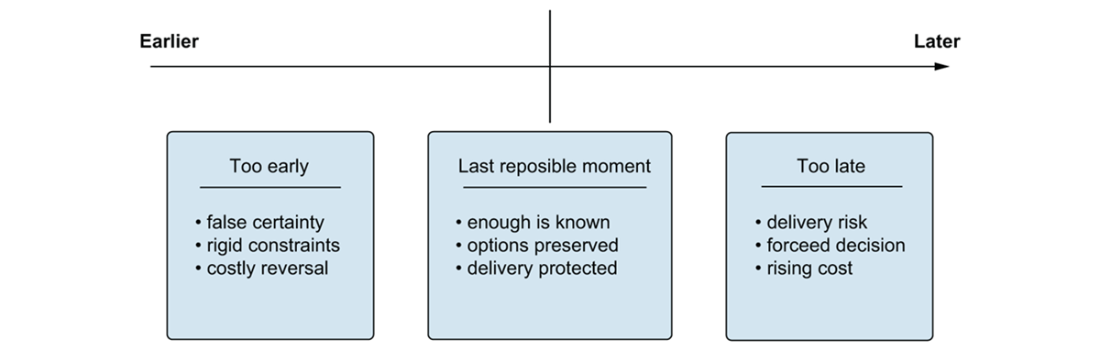
Use the decision-timing model to distinguish premature commitment, the last responsible moment, and delay that has begun creating delivery risk. section 4.4