Dense prediction assigns outputs across many spatial positions. In image segmentation, each pixel receives a label—such as road, car, or dog—so preserving object boundaries and location cues matters. Pooling and strided convolutions can erase this detail while compressing an image for classification. section 3.5
Dilated convolutions offer one way to expand a model’s receptive field without downsampling or enlarging the kernel. Gaps between kernel elements increase the spatial context covered while keeping the kernel’s parameter count unchanged. section 3.5
Pixel labels
A segmentation model distinguishes road, car, and dog pixels, requiring sharper outlines than a model that predicts one label for the whole image. section 3.5
Figure 3.6 Dilated convolutions rapidly expand the receptive field without increasing computational cost. Each dot represents a convolutional kernel element. As dilation increases (from left to right), the receptive field expands exponentially, capturing broader spatial context while keeping the parameter count the same. Used with permission granted by the lead author (Fisher Yu).
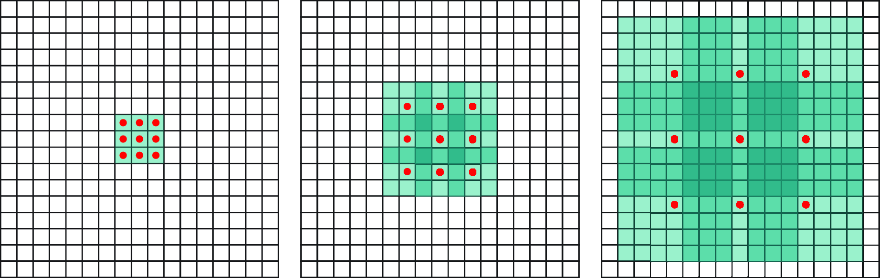
See how increasing dilation expands the receptive field while keeping the kernel elements—and parameter count—the same. section 3.5
