liveBook · Manning

Dense sampling

As explained in Deep Learning with R, Third Edition

Dense sampling is the collection of observations at sufficiently close locations throughout a relevant space to capture its structure.

Dense sampling collects observations at sufficiently close locations across the relevant input–output space, helping a model interpolate its structure and generalize. section 5.4.1 section 19.2.2

Use dense sampling as a practical dataset-collection rule:

  • Collect enough data to cover meaningful variation in the inputs and outputs. section 5.4.1
  • Improve coverage with data augmentation when models must generalize across factors of variation. section 19.2.2
  • Expect poor reliability when the problem is noisy, fundamentally discrete, or sparsely represented. section 5.4.1 section 19.2.2

Rocket landing

A model learning lunar-landing launch parameters would require tens of thousands or millions of launch trials to densely sample the input space. A physical model can derive a solution from far fewer trials. section 19.2.2

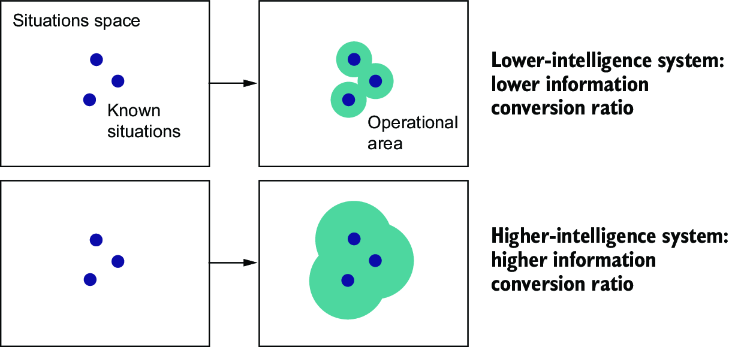
Figure 19.6 Local generalization vs. extreme generalization
figure

Compare local generalization from sampled regions with extreme generalization beyond the available data. section 19.2.2
How Deep Learning with R, Third Edition covers it

How deep it goes
Explains coverage and its generalization rationale, but stops short of specifying quantitative sampling thresholds or a formal sampling procedure.
Examples
Uses dataset curation guidance, augmented variation, lunar-landing trials, and city-navigation scenarios to illustrate coverage demands.
What it assumes
Builds on latent data structure and interpolation while treating dataset quantity and coverage as practical starting points.
What you can do after
Evaluate whether a learning problem has enough representative data for interpolation-based generalization.
How it connects
Connects dense sampling with generalization, interpolation, data augmentation, feature engineering, supervised learning, reinforcement learning, and physical models.

This explainer was generated by Manning's knowledge graph from the text of Deep Learning with R, Third Edition. The section links point to the parts of the book it draws on.