A density estimator is an unsupervised model that approximates the unknown probability distribution underlying sampled data. It measures how “crowded” different regions of a dataset are without requiring labels. section 7.0 section 7.3.3
In fragment-based drug discovery, compounds are represented by pharmacophoric features such as donors, acceptors, aromatics, and their three-dimensional arrangements. The estimated distribution captures which feature pair distances occur near a protein binding site. section 7.3 section 7.3.3
A practical density-estimation workflow is:
- Extract pharmacophoric features and coordinates from experimentally identified fragment hits. section 7.3.3
- Score new molecules by comparing their pharmacophore distance patterns with the fitted distributions for structure-based virtual screening. section 7.3.3
From crowded cities to binding sites
A city map estimates population density from how closely buildings are packed. Density estimation applies the same intuition to compounds: feature types describe intermolecular interactions, while their spatial geometry defines pharmacophores. section 7.3.3
Figure 7.14 Comparison of histogram and kernel density estimation on a bimodal distribution.
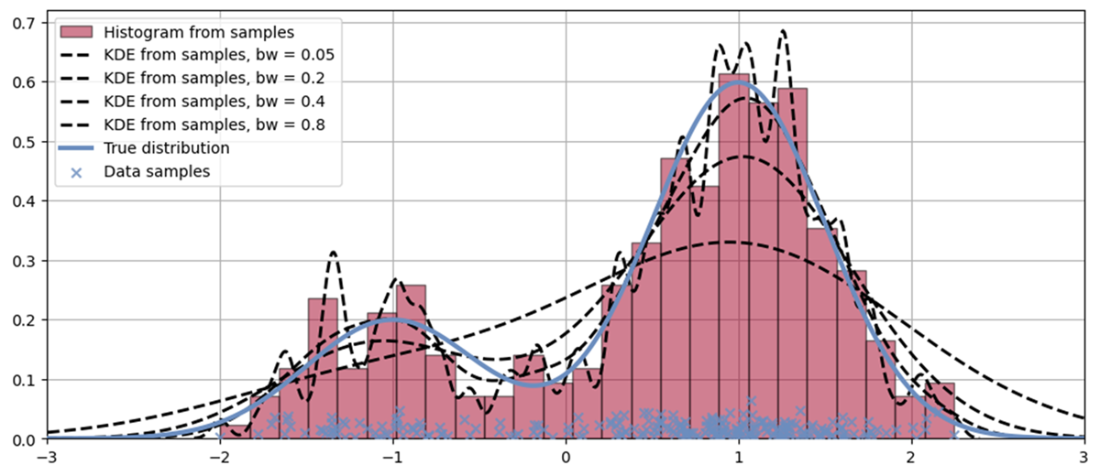
Compare a histogram with kernel density estimation on a bimodal distribution; the comparison motivates smoother distribution estimates. section 7.3.3

