A dependency ladder orders generative-AI exposure factors by prerequisites, not severity: lower factors must be present for higher factors to matter. Every system has environmental risk, and every LLM application adds another baseline. section 4.2
As exposure rises, additional capabilities create new paths to harm:
- Factor 3 enables AI-specific attacks such as prompt injection; Factor 4 data access can amplify them by exposing sensitive information. section 4.2
- Factor 5 lets the model take actions that can change or destroy data; Factor 6 agency adds multistep goal pursuit, typically involving lower layers. section 4.2
From chatbot to autonomous agent
A simple chatbot involves Factors 1–3; an action-enabled assistant adds Factors 4 and 5. A fully autonomous agent may handle untrusted input, access sensitive systems, take consequential actions, and rely on unaudited integrations. section 4.2
Figure 4.2 Security Risk Factors. Each additional factor compounds the risk.
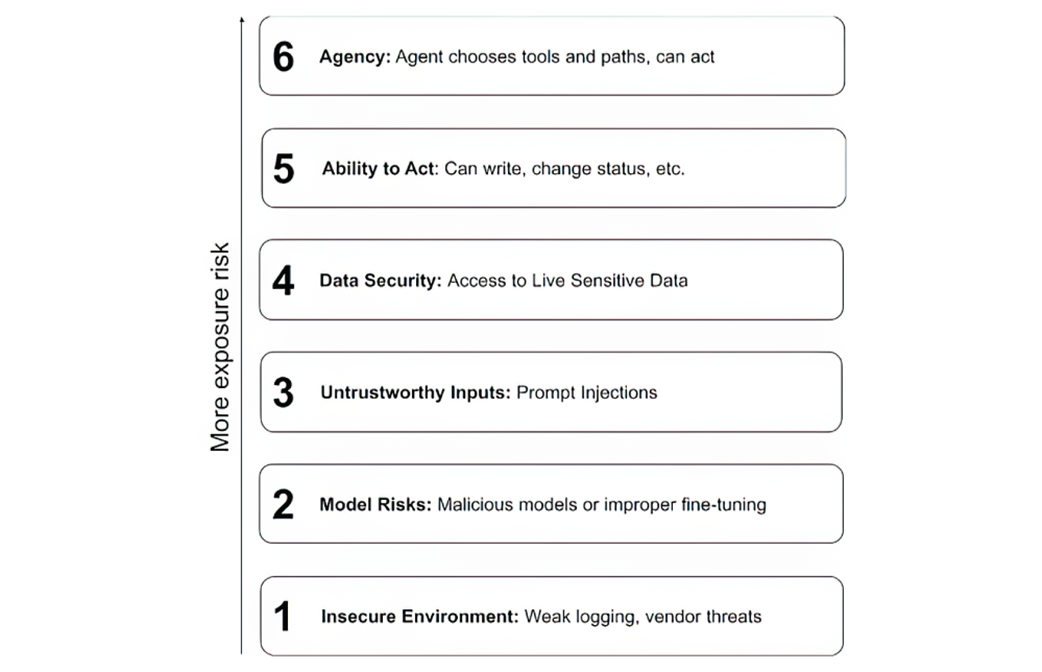
Use the figure to see how adding exposure factors compounds risk. section 4.2
