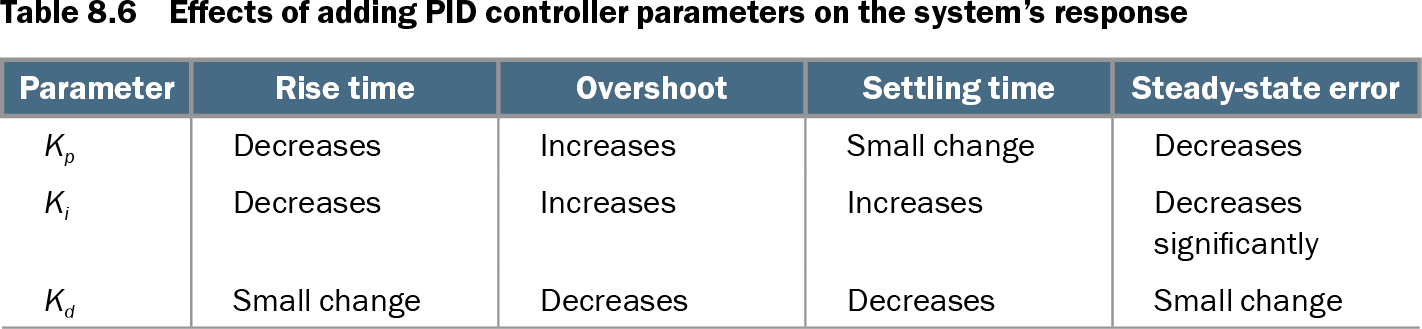
Derivative gain (Kd) is the PID parameter that scales the controller’s response to the rate of change of error. In a closed-loop system, it helps reduce overshoot and settling time while producing only a small change in rise time and steady-state error. section 8.7
Use derivative gain when tuning a PID response:
- Increase or optimize Kd to reduce overshoot and settling time. section 8.7
- Treat Kd as one of three coupled parameters with proportional gain and integral gain. section 8.7
- Evaluate candidate values through the system’s step response and measures such as overshoot, rise time, settling time, and steady-state value. section 8.7
Genetic-algorithm tuning
A Python tuning problem represents Kp, Ki, and Kd as three variables, evaluates each candidate through a transfer function, and uses a genetic algorithm to minimize a response criterion. The resulting parameters are tested by plotting the step response and calling control.step_info(T). section 8.7
Table 8.6 Effects of adding PID controller parameters on the system’s response (view table figure)
| Parameter |
Rise time |
Overshoot |
Settling time |
Steady-state error |
|---|---|---|---|---|
| Kp |
Decreases |
Increases |
Small change |
Decreases |
| Ki |
Decreases |
Increases |
Increases |
Decreases significantly |
| Kd |
Small change |
Decreases |
Decreases |
Small change |
Compare how Kp, Ki, and Kd change rise time, overshoot, settling time, and steady-state error. section 8.7