liveBook · Manning

Derivative term

As explained in Optimization Algorithms: AI techniques for design, planning, and control problems

A derivative term is a controller component whose output is proportional to the rate of change of error.

A derivative term is the PID component whose control output follows how quickly the error changes. It provides anticipatory action, helping the controller respond before the error grows further. section 8.7

Room-temperature control

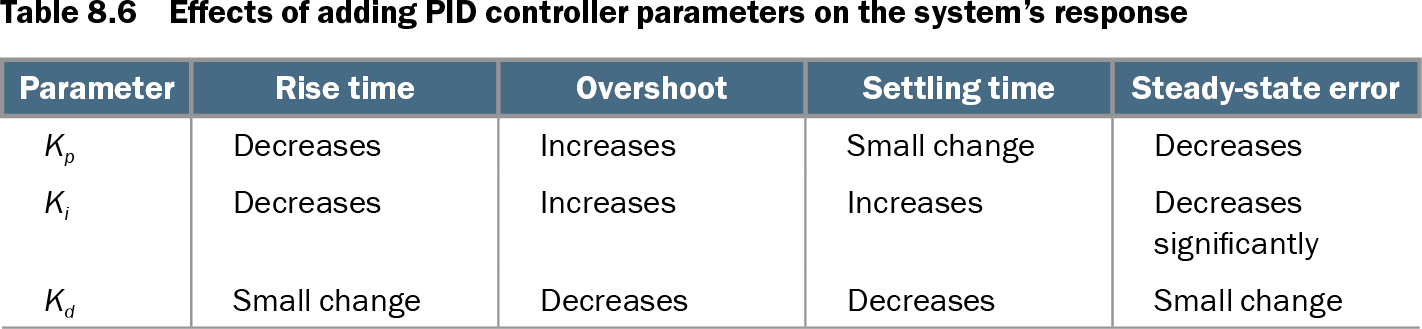
In a heater controller, error is the difference between the desired and measured room temperatures. The derivative term reacts to the rate of that difference: as temperature approaches the set point rapidly, it helps reduce overshoot. Increasing Kd typically decreases overshoot and settling time, while producing only a small change in rise time and steady-state error. section 8.7

Table 8.6 Effects of adding PID controller parameters on the system’s response (view table figure)

Parameter

Rise time

Overshoot

Settling time

Steady-state error

Kp

Decreases

Increases

Small change

Decreases

Ki

Decreases

Increases

Increases

Decreases significantly

Kd

Small change

Decreases

Decreases

Small change

Compare the typical effects of Kd with proportional and integral terms across rise time, overshoot, settling time, and steady-state error. section 8.7

How Optimization Algorithms: AI techniques for design, planning, and control problems covers it

How deep it goes
Explains the term’s role in the PID equation and response trade-offs, without detailing its standalone implementation.
Examples
Uses a room heater, set-point tracking, step response, and Kd response comparisons as concrete examples.
What it assumes
Assumes familiarity with PID control, feedback, error signals, and basic response measures such as overshoot and settling time.
What you can do after
Evaluate how changing Kd affects overshoot and settling time in a PID-controlled temperature response.
How it connects
Connects PID control with proportional control, integral control, error signals, overshoot, settling time, and steady-state error.

This explainer was generated by Manning's knowledge graph from the text of Optimization Algorithms: AI techniques for design, planning, and control problems. The section links point to the parts of the book it draws on.