liveBook · Manning

Deserialization

As explained in Microservices Patterns, Second Edition

Deserialization is the conversion of transmitted or stored data into in-memory application objects or structures.

API clients deserialize incoming payloads into domain objects the application can use. The payload may arrive in a response, reply, or consumed event, and its data model must conform to the service’s schema. section 8.1.7

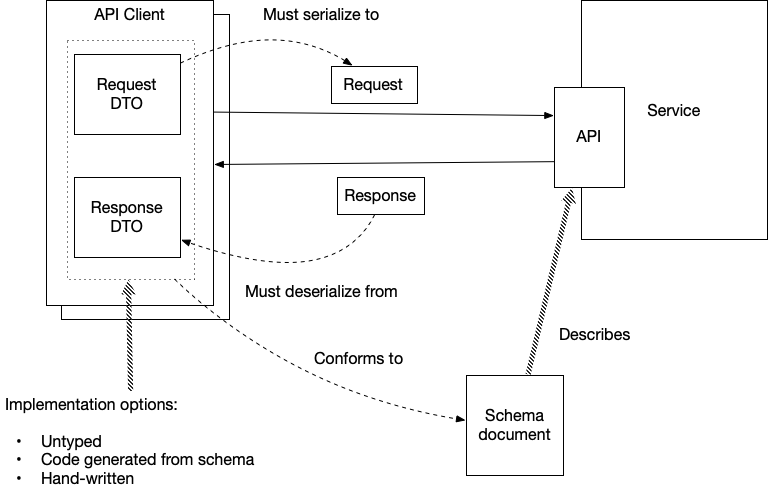
Client DTOs can be untyped structures, handwritten classes, code-generated classes, or libraries provided by the service team. For text-based formats, teams can choose between these approaches; binary formats usually use code generation. A client may model only the message types or fields relevant to its responsibilities. section 8.1.7

Figure 8.3 An API client must have a data model of the messages that it exchanges with the service. The data model must serialize and deserialize correctly as defined by the schema. It can either be untyped (e.g. hash maps) or consist of handwritten or code-generated classes.
defining api client dtos

Compare untyped data models with handwritten and code-generated classes for representing API messages. section 8.1.7


How Microservices Patterns, Second Edition covers it

How deep it goes
Explains schema-aligned DTO choices and partial projections without detailing parsing mechanics.
Examples
Uses responses, replies, and consumed events as inbound payload examples.
What you can do after
Evaluate DTO strategies by development effort, correctness, type safety, and design-time coupling.
How it connects
Connects deserialization with API clients, data transfer objects, schemas, and serialization.

Also explained in

Compare how 11 books explain deserialization →

Related concepts

This explainer was generated by Manning's knowledge graph from the text of Microservices Patterns, Second Edition. The section links point to the parts of the book it draws on.








