liveBook · Manning

Deserialize trait

As explained in Refactoring to Rust

serde::Deserialize is the Serde trait for constructing Rust values from serialized external data, with a corresponding derive macro for generating implementations.

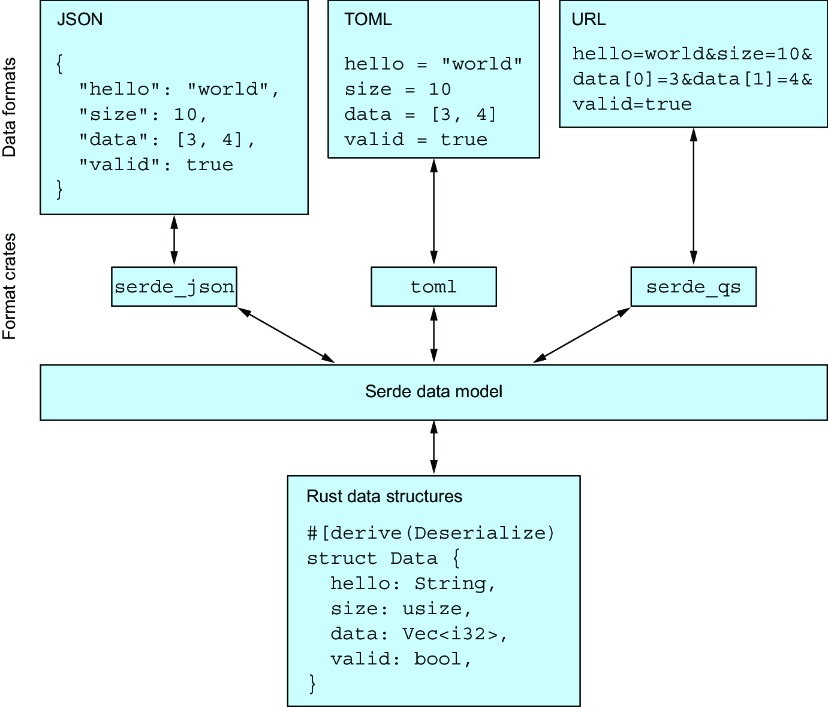
Serde’s Deserialize trait constructs Rust values from serialized data. It is format-independent: crates such as serde_json bridge the generic Serde data model to JSON and other formats. section 6.3

A typical JSON deserialization workflow is:

  • Define a Rust struct matching the input fields and types. section 6.3
  • Enable Serde’s derive feature and add serde_json as a dependency. section 6.3
  • Add #[derive(serde::Deserialize)] so the compiler generates the implementation. section 6.3 section 6.7
  • Give serde_json::from_str the expected type; mismatched input types produce a deserialization error. section 6.3 section 6.7

Parsing a JSON record

Use `#[derive(Debug, serde::Deserialize)]` on `struct Data { name: String, value: i32 }`, then call `let parsed: Data = serde_json::from_str(input).unwrap();`. Valid input becomes a `Data` value; declaring `name` as `i32` instead reports an invalid-type error. section 6.3

Figure 6.1 The Serde ecosystem
figure

Use the Serde ecosystem diagram to see how generic serialization and deserialization connect Rust data types with format-specific crates. section 6.3


How Refactoring to Rust covers it

How deep it goes
Explains the trait’s role and derive-generated implementation, but does not detail manual trait methods or internals.
Examples
Uses a name-and-value JSON object, a derived Data struct, compiler diagnostics, and a deliberately mismatched field type.
What it assumes
Assumes basic Rust structs and Cargo while introducing dependency configuration and Serde’s derive feature.
What you can do after
Apply it via serde_json::from_str to turn JSON strings into typed Rust values using generated implementations.
How it connects
Connects Serde with serialization, derive macros, serde_json, JSON, Rust structs, and generic data formats.

Also explained in

Compare how 2 books explain deserialize trait →

Related concepts

This explainer was generated by Manning's knowledge graph from the text of Refactoring to Rust. The section links point to the parts of the book it draws on.