Desirable mode is the active PAgP setting: a switch sends PAgP messages and attempts to form an EtherChannel with its neighbor. section 16.2.1
Remember these pairing and configuration rules:
- Pair desirable with desirable or auto to form an EtherChannel; auto with auto does not negotiate one. section 16.2.1
- Assign member ports with channel-group 1 mode desirable; the command creates the logical Port-channel1 interface. section 16.2.1
- Configure access or trunk settings on the port-channel interface, where settings are inherited by member ports. section 16.5
Two-switch PAgP example
On SW1, configure interface range g0/0-1 with channel-group 1 mode desirable. Configure SW2’s matching ports with mode auto. Verify bundling with show etherchannel summary; use show pagp neighbor to inspect PAgP neighbors.
Figure 16.5 An EtherChannel is formed between SW1 and SW2 using PAgP. SW1’s G0/0 and G0/1 ports are configured in PAgP desirable mode, and SW2’s G0/0 and G0/1 ports are configured in PAgP auto mode. switchport mode trunk is applied to each switch’s port channel interface to make the EtherChannel a trunk.
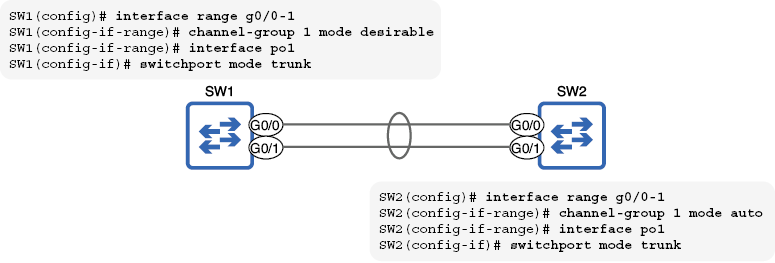
Visualizes desirable-to-auto negotiation and the resulting trunk EtherChannel. section 16.2.1
