liveBook · Manning

Determinant

As explained in Geometry for Programmers

A determinant is a scalar computed from a square matrix that encodes algebraic properties such as invertibility and signed volume scaling.

A determinant is a scalar computed from a square matrix. Geometrically, it gives the signed volume of the parallelepiped formed by the matrix’s vectors: magnitude measures volume, while sign records orientation. section 9.4.1

The determinant provides an alternative route to the triple product. Form a matrix from the vectors and evaluate its determinant; swapping vector order can reverse the sign without changing the volume’s magnitude. section 9.4.1

A practical workflow is:

  • Arrange vector components as the rows or columns of a square matrix. section 9.4.1
  • Use SymPy’s .det() operation instead of expanding multidimensional formulas by hand. section 9.5.3
  • Prefer numeric solvers as dimensions grow; symbolic expressions expand factorially and straightforward numeric accuracy declines. section 9.5.3

A unit-volume reference

The vectors (1, 0, 0), (0, 1, 0), and (0, 0, 1) form a parallelepiped with volume 1, so their determinant is 1. section 9.4.1
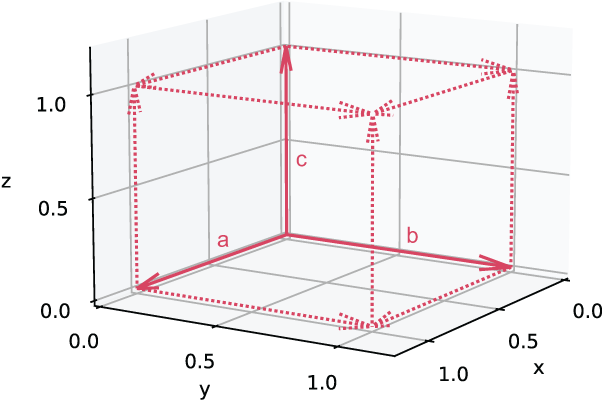
Figure 9.19 The volume of the parallelepiped formed by (1, 0, 0), (0, 1, 0), and (0, 0, 1) is 1.
09-19

Use the figure to connect the determinant with the volume of a parallelepiped. section 9.4.1

A = Matrix([[a1, a2], [b1, b2]])
print(A.det())

Use the listing to see the smallest SymPy determinant computation and its compact 2D result. section 9.5.3


How Geometry for Programmers covers it

How deep it goes
Explains orientation and volume, demonstrates SymPy through 4D, and defers alternative large-dimension algorithms.
Examples
Uses unit vectors, 2D through 4D symbolic matrices, and SymPy determinant listings.
What it assumes
Assumes familiarity with vectors, matrices, cross products, and dot products while relating their operations to determinants.
What you can do after
Apply via SymPy to compute small-dimensional symbolic determinants and recognize when numeric solvers are more suitable.
How it connects
Connects determinants to vectors, cross products, dot products, triple products, box products, parallelepipeds, and linear systems.

Also explained in

Compare how 2 books explain determinant →

Related concepts

This explainer was generated by Manning's knowledge graph from the text of Geometry for Programmers. The section links point to the parts of the book it draws on.