Customer data often arrives in separate records, making it hard to tell which activity belongs to the same person or company. Deterministic cascade matching links records by trying prioritized, rules-based matching conditions in sequence until one succeeds or a base case is reached. It is a foundational identity-resolution option alongside single-field and composite-key matching. section 6.1.1 section 6.4
The appeal is operational clarity: a rules-based approach can be understood by teams, monitored with practical checks, and anchored to a primary source of truth such as transaction data. Match quality still matters. Linking different people creates a false positive; failing to link related records creates a false negative. No particular rule order fits every organization. section 6.1.1 section 6.4
Matching company records
A company-record cascade can use fields such as company name, headquarters, key employees, and a D-U-N-S identifier. Because sales teams may enter account details into a CRM, data hygiene and manual review of duplicate accounts remain important. Consolidated company records help lead scoring reflect activity across contacts at the same company. section 6.1.2
Figure 6.5 Diagram demonstrating deterministic cascade identity resolution
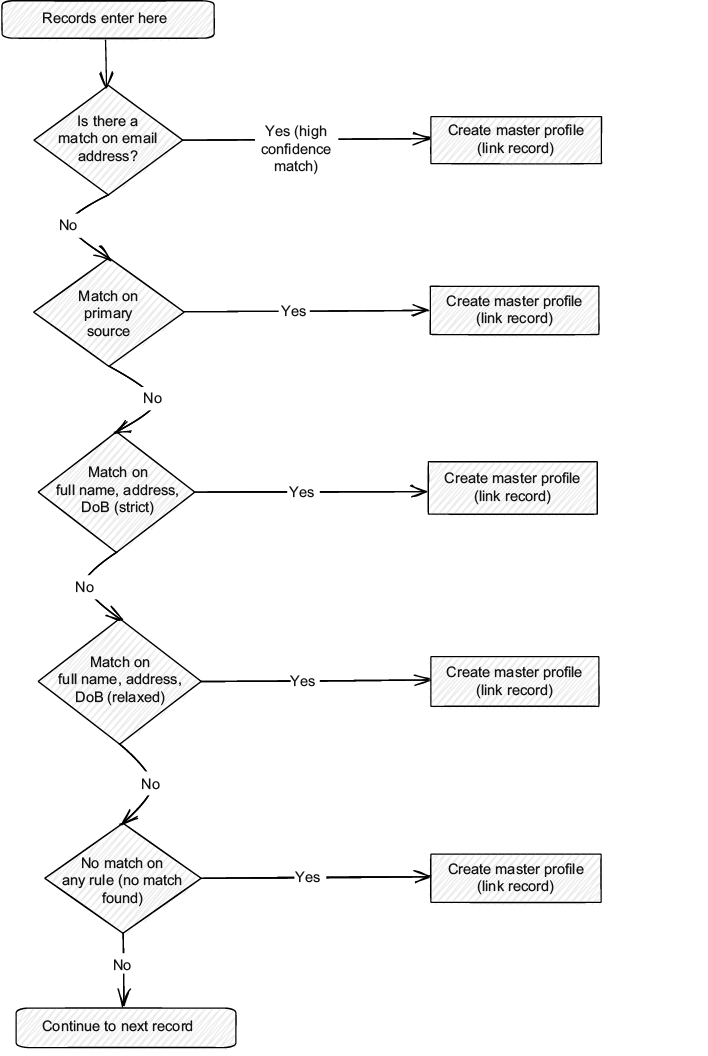
View the diagram for a visual illustration of deterministic cascade identity resolution. section 6.1.1
