A deterministic check is a code- or schema-based control point that evaluates a condition repeatably. It makes pass/fail branches dependable instead of leaving them to stochastic model judgment. section 4.6
Use it like a checkpoint on an assembly line: inspect the typed result before passing it downstream. In agent evaluation, it suits exact correctness; LLM evaluators handle judgments of degree, while humans handle edge cases and policy concerns. section 4.6 section 7.1
Place deterministic checks where a flow needs repeatable decisions:
- Validate that an agent returned the expected schema before allowing the next node to use the result. section 7.1
- Confirm that the correct tool was called or that output matches a known-good answer. section 7.1
- Reject, retry, or correct invalid data before it corrupts a multi-agent flow. section 4.6
- Keep checks explicit at routing boundaries rather than relying on an agent’s stochastic pass/fail judgment. section 4.6
Schema checkpoint
An agent produces a typed result for the next node. A schema check accepts the result only when it has the expected structure; otherwise, the flow rejects or retries it before continuing. section 4.6 section 7.1
Figure 7.1 The external agent evaluation and feedback systems for a single user-facing agent. In the figure, a generative agent may face evaluation from a critic for general output feedback or from a grounding agent for context-specific feedback and evaluation.
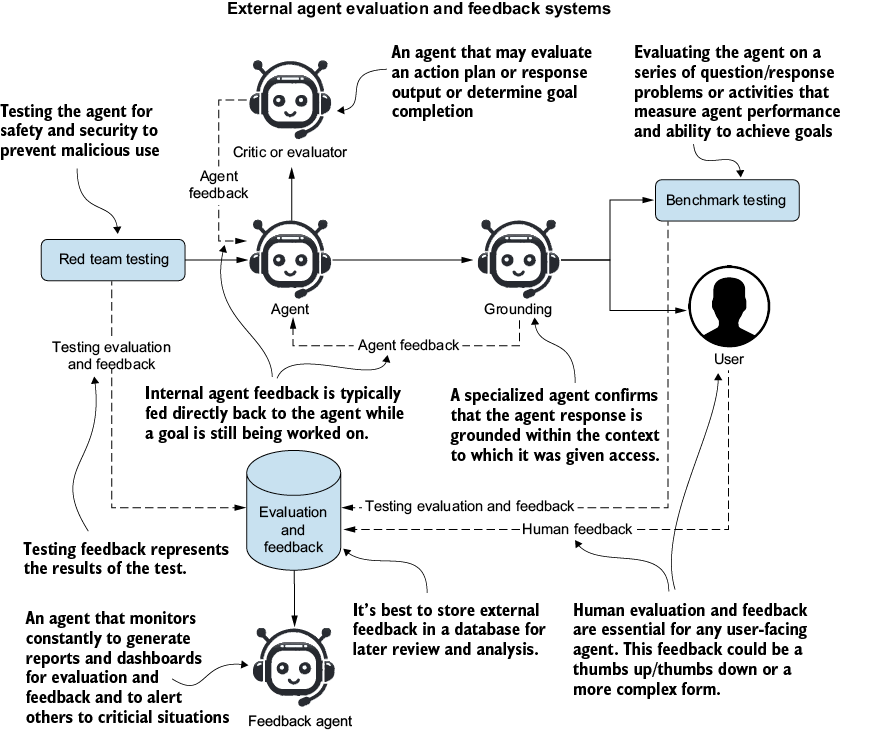
Use the evaluation-system diagram to place deterministic checks alongside critic, grounding, and human feedback paths. section 7.1
