Deterministic context assembly prepares a repeatable, task-specific context before an AI agent starts. Curating roughly fifteen tools from a larger catalog and prefetching relevant context reduces exploration, iteration, and context noise. section 3.3.5
Apply the technique with disciplined controls:
- Treat MCP servers as production dependencies rather than exposing every available integration. section 3.3.5
- Maintain a team-approved allowlist, document each enabled server and its purpose, and review configuration during onboarding. section 3.3.5
- Separate standardized discovery and invocation from tool accuracy, tool selection, and whether results reach the model's usable context. section 3.3.5
Figure 3.5 MCP Governance layers - the agent communicates through an MCP Gateway (enforcing auth and policies), which routes to an MCP Proxy (aggregating multiple servers into a curated toolset), which connects to individual MCP servers registered in a central catalog. Each layer adds security and reduces context noise.
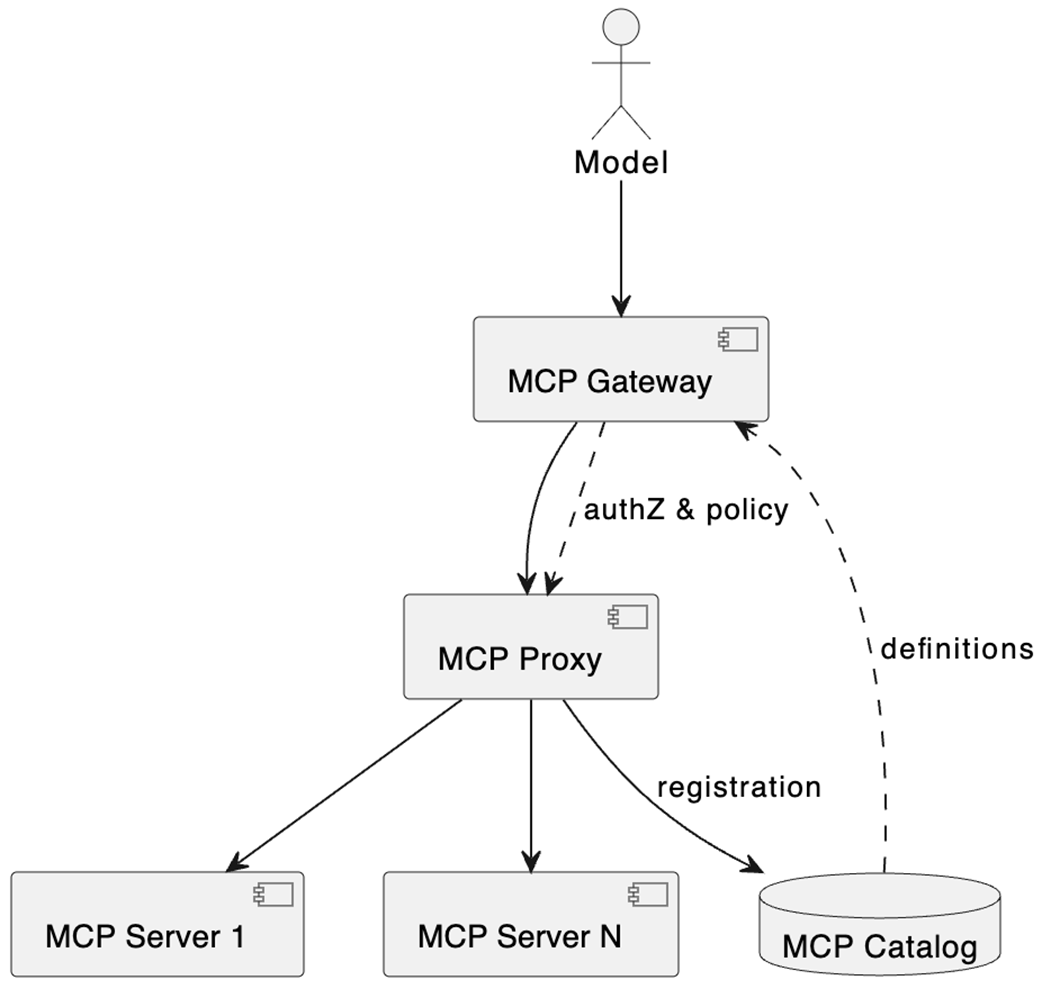
Use the layered governance model to connect centralized catalogs, curated proxies, gateways, authentication, policies, and reduced context noise. section 3.3.5
