liveBook · Manning

Development-time quality attribute

As explained in Microservices Patterns, Second Edition

A development-time characteristic is a property of software development affected by how software elements are designed, built, or changed.

Development-time quality attributes describe desired properties of software development, including ease and speed of development and deployment. Modifiability, testability, and deployability are examples; architecture helps an application satisfy these qualities. section 3.1.3 section 3.5

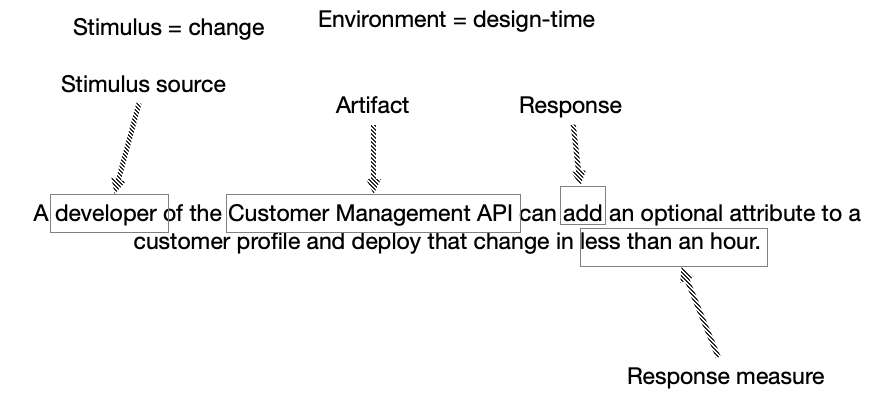
Specify these requirements as scenarios. Each scenario identifies a stimulus, its source, the resulting response, a response measure, the environment, and the affected artifact. section 3.1.3

Figure 3.4 An example modifiability scenario, which describes how long it should take for a developer to make a change and deploy it
modifiability scenario

A modifiability scenario makes the expected time to change and deploy explicit. section 3.1.3

How Microservices Patterns, Second Edition covers it

How deep it goes
Names modifiability, testability, and deployability, and frames requirements as six-part scenarios.
Examples
Uses a modifiability scenario that specifies how long a developer should take to make and deploy a change.
What you can do after
Evaluate/understand development-time requirements by expressing stimuli, sources, responses, measures, environments, and affected artifacts.
How it connects
Connects architecture and quality-attribute scenarios with modifiability, testability, deployability, and runtime quality attributes.

Related concepts

This explainer was generated by Manning's knowledge graph from the text of Microservices Patterns, Second Edition. The section links point to the parts of the book it draws on.