liveBook · Manning

Die

As explained in Learn AI-Assisted Python Programming, Second Edition

A die is a numbered game object rolled to produce a random value, typically from one through six.

A die is a numbered game object rolled to produce a random value, typically from one through six. section 10.4.1

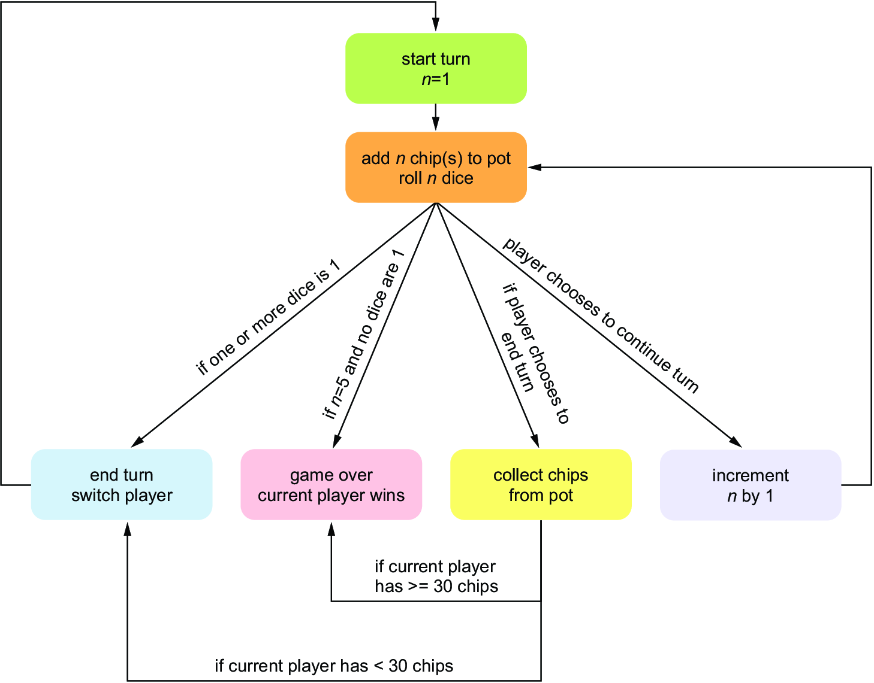
In Bogart, a player begins a turn by rolling one die. If the result is not 1, the player may continue by rolling two, three, four, and five dice in sequence. section 10.4.1

A die in Bogart

Rolling a 1 ends the turn without awarding the pot. Rolling no 1s lets the player choose whether to stop and collect the chips or continue with more dice. section 10.4.1

Figure 10.5 Player turn in Bogart
figure

Follow the player-turn flow from the initial die roll through continuing, stopping, or losing the turn. section 10.4.1

How Learn AI-Assisted Python Programming, Second Edition covers it

How deep it goes
Explains sequential rolls and the effect of rolling 1, while deferring detailed implementation to game functions.
Examples
Uses Bogart’s one-to-five-dice turn sequence, chip pot, and rolling-a-1 failure condition.
What you can do after
Build it from scratch as a random roll within a decomposed game-turn implementation.
How it connects
Connects dice rolls with turns, random number generation, game loops, and functions.

Related concepts

This explainer was generated by Manning's knowledge graph from the text of Learn AI-Assisted Python Programming, Second Edition. The section links point to the parts of the book it draws on.