liveBook · Manning

Differential advantage

As explained in Architecture Modernization: Socio-technical alignment of software, strategy, and structure

Differential advantage is an advantage from offering a product or service that is superior or distinct in ways valued by customers.

Differential advantage comes from offering products or services that customers value as superior or distinct, such as through better features or usability. It differs from comparative advantage, which extracts greater profit while delivering a similar offering. section 5.3.1 section 5.6

Strategic importance depends on how users and industry perceive the component and where value is concentrated. An advantage may have high future potential even before it produces positive returns. section 5.3.1

Use these contrasts when assessing a component:

  • A commodity menu is generally a cost of doing business and a table-stakes feature, not a major investment priority. section 5.3.1
  • Restaurant optimization can differentiate an offering by helping restaurants become more profitable and attracting their customers as partners. section 5.3.1
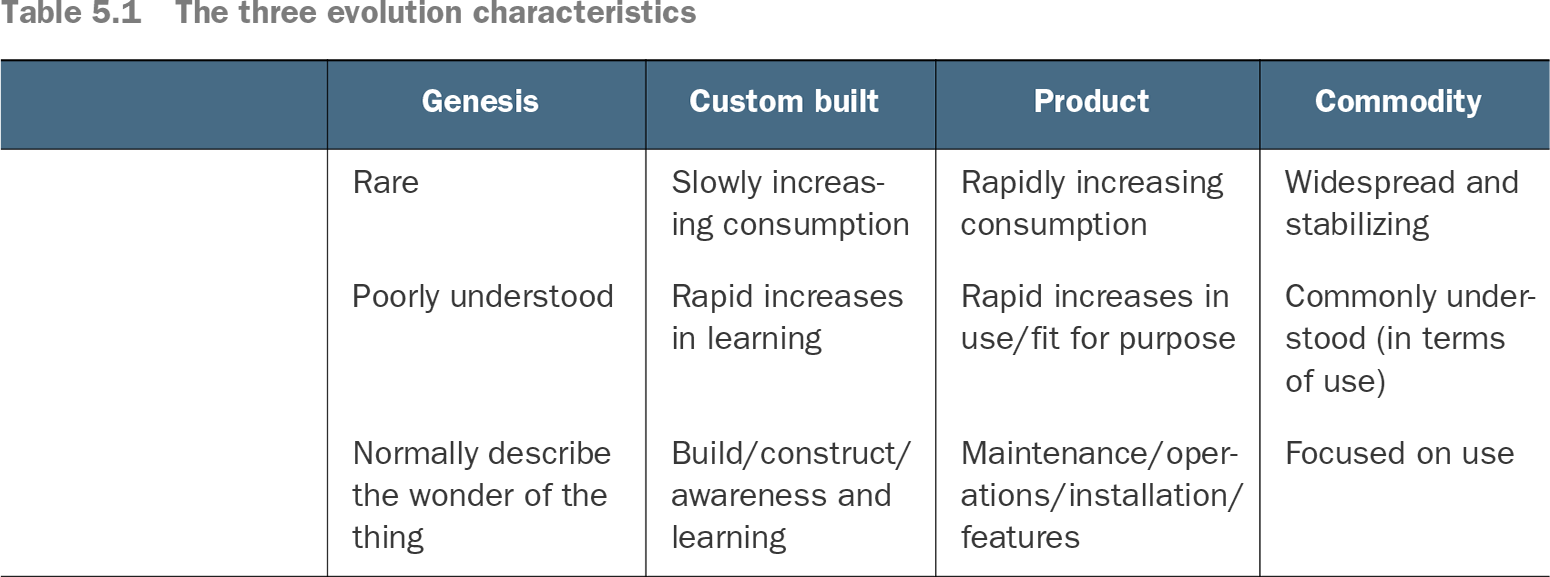
  • Compare the advantage with evolution characteristics such as ubiquity and certainty, then account for competitor actions and changing world events. section 5.6

Restaurant optimization

A company that improves restaurant profitability may gain a differential advantage even when the work currently costs more than it returns. Its future potential can justify continued attention, unlike routine menu maintenance. section 5.3.1

Table 5.1 The three evolution characteristics (view table figure)


Genesis

Custom built

Product

Commodity

Ubiquity

Rare

Slowly increasing consumption

Rapidly increasing consumption

Widespread and stabilizing

Certainty

Poorly understood

Rapid increases in learning

Rapid increases in use/
fit for purpose

Commonly understood (in terms of use)

Publication types

Normally describe the wonder of the thing

Build/
construct/
awareness and learning

Maintenance/
operations/
installation/ features

Focused on use

Use the evolution-characteristics table to compare components by product maturity, market growth, user perception, industry perception, and focus of value. section 5.3.1

How Architecture Modernization: Socio-technical alignment of software, strategy, and structure covers it

How deep it goes
Defines differential advantage, contrasts it with comparative advantage, and relates it to evolution characteristics and strategic priorities.
Examples
Uses restaurant menus as commodities and restaurant optimization as a potentially valuable source of differentiation.
What you can do after
Evaluate whether a component represents a distinctive advantage, a comparative advantage, or routine cost of doing business.
How it connects
Connects differential advantage with competitive advantage, comparative advantage, commodities, evolution characteristics, and Wardley Maps.

Related concepts

This explainer was generated by Manning's knowledge graph from the text of Architecture Modernization: Socio-technical alignment of software, strategy, and structure. The section links point to the parts of the book it draws on.