liveBook · Manning

Diffraction

As explained in Acing the CCNA Exam: Volume 2 Advanced Networking and Security

Diffraction is the bending and spreading of a propagating wave around obstacles or through openings.

Diffraction is the bending and spreading of wireless waves around the edges of obstacles such as walls. It can allow communication without a clear line of sight between transmitter and receiver. section 18.1.2

In wireless LAN planning, diffraction is one factor shaping coverage and reliability alongside absorption, reflection, refraction, scattering, and free-space path loss. section 18.1.2 section 18.1.1

Urban coverage

Diffraction can help a wireless signal reach street-level or indoor areas that are not directly visible from a cell tower or wireless access point. section 18.1.2

Figure 18.4 Phenomena affecting the behavior of electromagnetic waves include absorption by a medium, reflection off surfaces, refraction (bending) as waves pass through a medium, diffraction around obstacles, and scattering from irregularities.
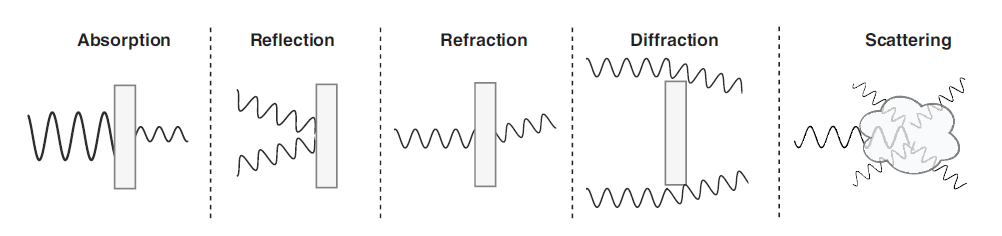
Compare diffraction with absorption, reflection, refraction, and scattering in the diagram of electromagnetic-wave behavior. section 18.1.2

How Acing the CCNA Exam: Volume 2 Advanced Networking and Security covers it

How deep it goes
Defines bending and spreading around obstacles, gives wireless examples, and stops short of detailed WLAN design.
Examples
Uses walls, urban street-level coverage, and indoor areas outside direct view of a tower or access point.
What you can do after
Evaluate how obstacles can affect wireless coverage and distinguish diffraction from other wave behaviors.
How it connects
Connects diffraction with absorption, reflection, refraction, scattering, free-space path loss, and line-of-sight coverage.

This explainer was generated by Manning's knowledge graph from the text of Acing the CCNA Exam: Volume 2 Advanced Networking and Security. The section links point to the parts of the book it draws on.