A digital signature is a cryptographic value that proves authorship and detects document changes. The signer uses a private key and the document’s hash; anyone with the corresponding public key, document, and signature can verify the result. Changing even one bit causes verification to fail. section 1.3.2 section 5.0
A typical signature workflow separates signing, publication, and verification:
- Generate or obtain a private-key and public-key pair, keeping the private key secret. section 1.3
- Hash the document and combine that hash with the private key to produce a signature. section 1.3.2
- Distribute the document, signature, and a way to locate or validate the signer’s public key. section 5.0
- Recompute the document hash and use the public key to accept or reject the signature. section 1.3.2
Elliptic-curve signatures operate over a finite field with a base point B of prime order n. In Schnorr signing, choose a fresh random k, compute Q = kB, hash Q and the document to obtain e, and calculate s = k − e·privateKey mod n. Verification checks whether Q equals sB + e·publicKey; substituting the signing equation makes the private-key terms cancel. ECDSA uses the message hash, a random value, and the private key to produce two signature values, then performs a more involved public-key check. section 5.1.1 section 5.4
Figure 5.1 Schnorr signature steps
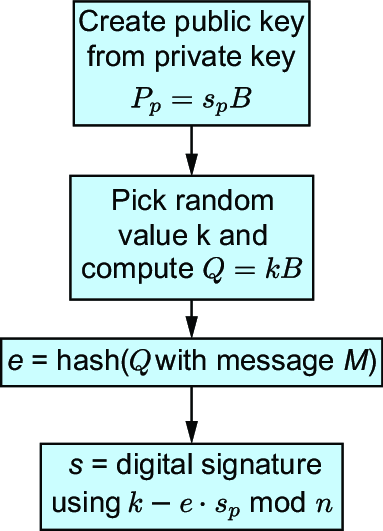
Follow the signature-step diagram to connect key generation, nonce selection, hashing, signature construction, and verification. section 5.1.1
Signature mathematics does not by itself establish that a public key belongs to the claimed signer; key exchange methods, certificates, or database checks address that separate security problem. Pairing-based aggregation can combine many signatures into smaller blockchain storage and transmission costs. section 5.0 section 1.5







