Dijkstra's algorithm, also called Shortest Path First (SPF), calculates minimum-cost routes from a network topology map. OSPF routers use it after building an identical link-state database (LSDB). section 18.0 section 18.1.1
Apply the process in this order:
- Build the LSDB from link-state advertisements (LSAs) flooded throughout the OSPF area. section 18.1.1
- Calculate a path to each destination by comparing cumulative interface costs. section 18.5
- Recalculate when topology changes; multi-area OSPF limits the affected LSDB and SPF work to smaller areas. section 18.1.2
Routing to 10.1.1.0/24
Each router uses the shared LSDB as a detailed network diagram, including link costs, and runs SPF to select the lowest-cost route to 10.1.1.0/24. section 18.1.1
Figure 18.1 Routers flood LSAs within the OSPF area to ensure all routers have an identical LSDB. The LSAs that make up the LSDB contain information about each router’s connected networks, such as their cost. R1’s LSA indicates that it is connected to 10.0.0.0/30, 10.0.0.4/30, and 10.1.1.0/24, each with a cost of 1.
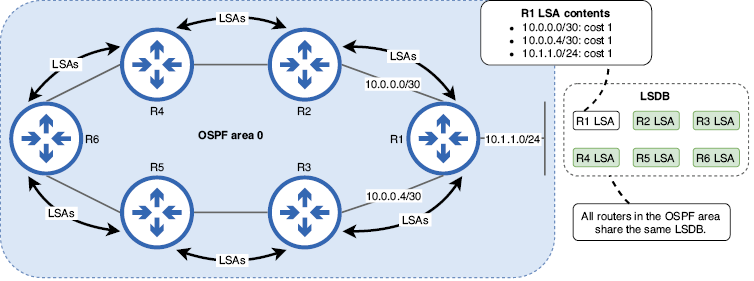
Trace how routers flood LSAs and how those advertisements record connected networks and interface costs. section 18.1.1




