A directly connected static route specifies only the exit interface, not a next-hop IP address. The router therefore treats the destination network as directly connected. section 9.3.1 section 9.4
IPv4 configuration and routing-table result
On R1, configure a route to 192.168.3.0/24 through GigabitEthernet0/0: `R1(config)# ip route 192.168.3.0 255.255.255.0 g0/0`. The route appears as `S 192.168.3.0/24 is directly connected, GigabitEthernet0/0` in `show ip route`. section 9.3.1
Understand the forwarding consequence before choosing this route type:
- The router sends an ARP request for the final destination host rather than for the next-hop router. section 9.3.1
- Because broadcasts remain on the local network, the request reaches the neighboring router but not the remote host. section 9.3.1
- IPv4 forwarding can work when the neighboring router uses proxy ARP; Cisco routers enable proxy ARP by default, but other vendors might not. section 9.3.1 section 9.4
- A fully specified static route supplies both the exit interface and next-hop IP address, avoiding reliance on this route form’s proxy-ARP behavior. section 9.4
Figure 9.10 A proxy ARP exchange between R1 and R2. (1) R1 sends an ARP request to learn PC3’s MAC address. (2) 192.168.3.11 isn’t R2’s IP address, but R2 has a route to 192.168.3.0/24 in its routing table, so R2 uses proxy ARP to reply on behalf of PC3.
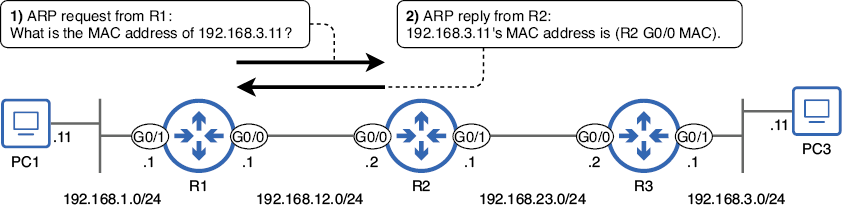
Trace the proxy ARP exchange in which R2 answers R1 on behalf of the remote host. section 9.3.1
IPv6 warning
The analogous command `ipv6 route 2001:db8:3::/64 g0/0` is accepted and appears as directly connected, but Cisco IPv6 forwarding fails because proxy NDP is not supported. An incomplete neighbor entry confirms the failure. section 21.3.1
For exam questions, classify the destination separately from next-hop specification: a network or host route describes the destination, while directly connected, recursive, and fully specified describe how forwarding information is supplied. section 9.3.2
