A discrete problem selects from distinct configurations, decisions, or values rather than continuously varying quantities. In optimization, integer-valued variables define discrete problems; solutions formed from sets, combinations, or permutations are combinatorial problems. section 2.1.1
Classify a problem by the structure of its decisions:
- Use integer or discrete optimization when variables take integer values. section 2.1.1
- Use mixed-integer optimization when continuous and integer decisions appear together, such as elevator motion and passenger-pickup order. section 2.1.1
- Use combinatorial optimization when solutions are sets, combinations, or permutations; order distinguishes permutations from combinations. section 2.1.1
From exercise plans to routes
A weekly fitness plan choosing three activities from five, with repetition allowed, produces 35 combinations. A traveling-salesperson problem instead searches ordered routes through cities, where changing the order changes the solution. Constraint problems provide another form: a 7-queens arrangement is discrete because each queen occupies a position on a discrete chessboard. section 2.1.1 section 6.3
Combinations and permutations—permutations respect order and are thus ordered combinations. Both combinations and permutations have variants with and without repetition.
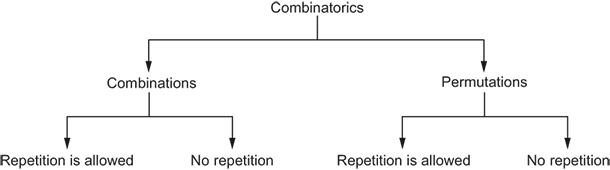
Compare combinations and permutations visually, including variants with and without repetition. section 2.1.1
