In a support vector machine, the distance error penalizes two parallel boundary lines when they sit too close together. For lines with equations w₁x₁ + w₂x₂ + b = 1 and w₁x₁ + w₂x₂ + b = −1, it is w₁² + w₂²: smaller values correspond to lines farther apart. section 11.1
This term works alongside classification error: one rewards wider spacing, while the other penalizes misclassified points. A combined error can balance the two. section 11.1
Figure 11.7 Left: An SVM where the lines are at distance 0.4 apart, with an error of 25. Right: An SVM where the lines are at distance 0.04 apart, with an error of 2500. Notice that in this comparison, the classifier on the left is much better than the one on the right, because the lines are farther apart from each other. This results in a smaller distance error.
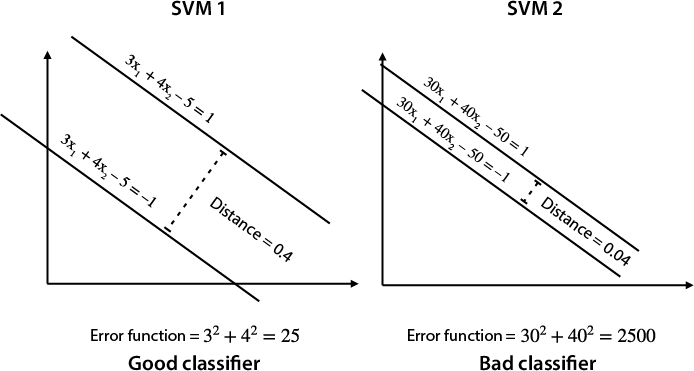
Compare how narrower boundary spacing corresponds to a much larger distance error. section 11.1
