liveBook · Manning

Distributed denial of service attack

As explained in Secure APIs

A distributed denial-of-service attack is a denial-of-service attack that uses traffic or requests from multiple distributed sources to overwhelm a service or resource.

A distributed denial-of-service (DDoS) attack overwhelms a service by sending many concurrent requests from multiple sources. Exhausted resources can take services offline or drive uncapped cloud costs beyond business limits. section 5.1

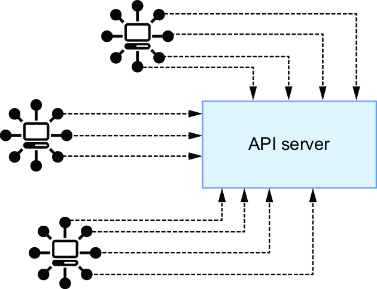
Figure 5.1 Unrestricted resource consumption happens when threat actors get unfettered access to our servers. In this example, a threat actor launches a DDoS attack from three servers.
figure

A three-server request flood illustrates how unrestricted access to servers becomes distributed resource exhaustion. section 5.1

Reduce exposure with layered controls:

  • Analyze traffic for anomalies, apply CAPTCHA or other challenges, and temporarily ban suspicious clients. section 5.1.1
  • Deploy a web application firewall or a DoS mitigation service such as Cloudflare, Akamai, Radware, or Imperva. section 5.1.1
  • Rate-limit computationally intensive and data-sensitive endpoints more strictly than routine endpoints, using thresholds aligned with real usage. section 5.1.1


How Secure APIs covers it

How deep it goes
Explains request flooding, cloud cost escalation, layered defenses, and endpoint-specific rate limits, stopping short of implementation detail.
Examples
Illustrates three attacking servers, expensive analytics requests, and serverless platforms such as AWS Lambda, GCP, and Azure Functions.
What you can do after
Operate/configure layered protections and tailor rate limits to endpoint cost, sensitivity, and legitimate user flows.
How it connects
Connects denial of service with unrestricted resource consumption, rate limiting, web application firewalls, serverless computing, and traffic anomaly detection.

Also explained in

Compare how 3 books explain distributed denial of service attack →

Related concepts

This explainer was generated by Manning's knowledge graph from the text of Secure APIs. The section links point to the parts of the book it draws on.
