A distributed monolith splits an application into separately deployed services but leaves them logically coupled. It has the network complexity of distributed systems without the agility of genuinely independent services. section 12.2.4 section 12.11
Two common traps create this pattern:
- A shared database lets a schema change break multiple services at once. section 12.2.4
- Synchronous service calls make one service’s success depend on another’s availability. section 12.2.4
An order that waits on every service
An Order API checks inventory, charges payment, then asks Shipping to print a label. If each call takes 200 ms, the user waits at least 600 ms; if Shipping is down, the order fails despite available stock and a successful payment. Queueing label printing for later breaks this fragile synchronous chain. section 6.8.4 section 6.8.4
Figure 12.2 A Distributed Monolith provides the illusion of separation, but maintains extreme logical coupling. It is a monolithic ball of mud stretched across a fragile network.
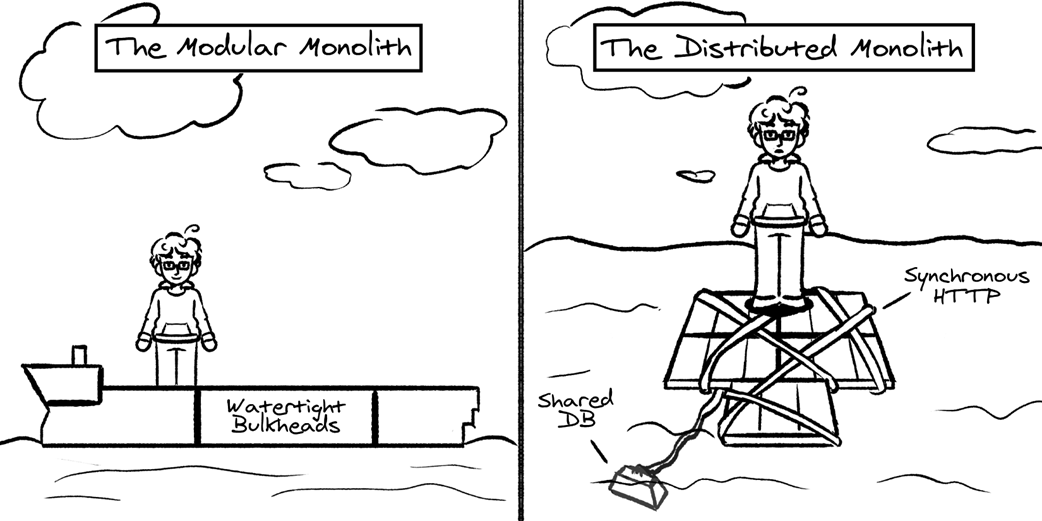
Shows the illusion of service separation and the logical coupling underneath. section 12.2.4
Figure 6.14 Avoiding the Distributed Monolith: Breaking a fragile synchronous chain with an asynchronous queue ensures critical tasks succeed even if non-critical services fail.
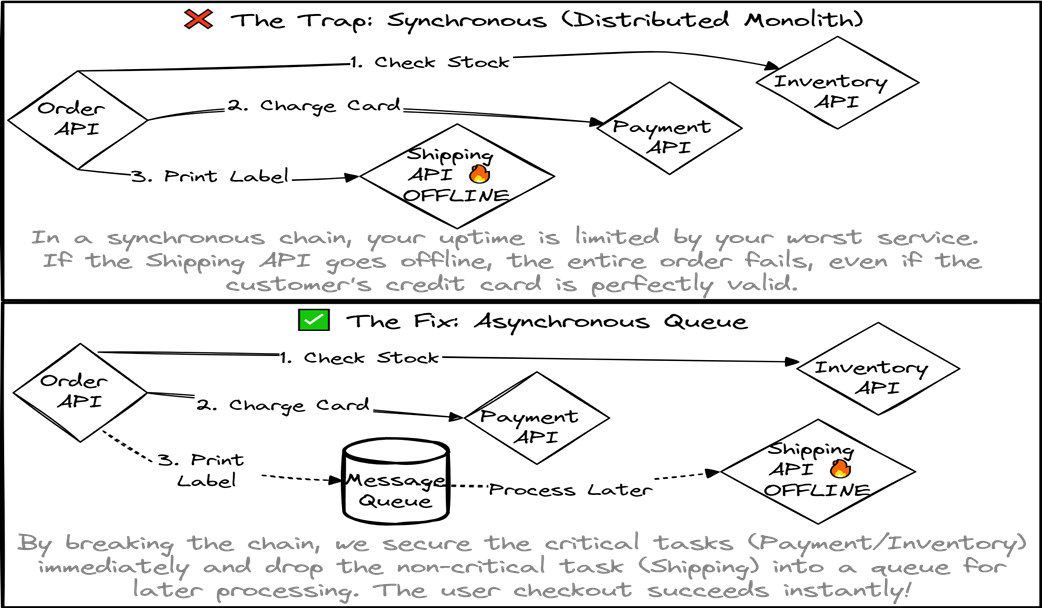
Illustrates how queueing a noncritical task can protect the user-facing operation when a downstream service fails. section 6.8.4

