A distributed query processor executes queries across data stored in multiple locations. Atlas Data Federation combines Atlas sources, external cloud storage, and HTTP endpoints while keeping data in its original location and format. section 16.0 section 16.6
Federated database instances expose virtual databases and collections that map to existing data stores. JSON storage configuration defines these mappings, allowing queries, transformations, and data transfers across sources. section 16.2
Atlas Data Federation separates responsibilities across four architectural planes:
- Application and Services provides interfaces through tools such as MongoDB Compass, language drivers, and data science tools. section 16.2
- The Control Plane orchestrates requests and aggregates final results across the distributed environment. section 16.2
- The Compute Plane processes requests with elastic compute nodes placed near data sources to reduce latency and data transfer. section 16.2
- The Data Plane retains the underlying data in Atlas clusters, online archives, cloud storage, or HTTP endpoints. section 16.2
Combining historical and live data
Create virtual collections mapped to live Atlas data and historical data in Atlas Online Archive or cloud storage, then run analytical queries across the combined view for strategic analysis. section 16.0 section 16.6
Manage a federated database instance through the Atlas UI or command-line interface. Atlas SQL is enabled by default when an instance is created, but charges depend on the volume of data processed and returned. section 16.6
Figure 16.2 The architecture of Atlas Data Federation (Image © MongoDB 2024 CC BY-NC-SA 3.0)
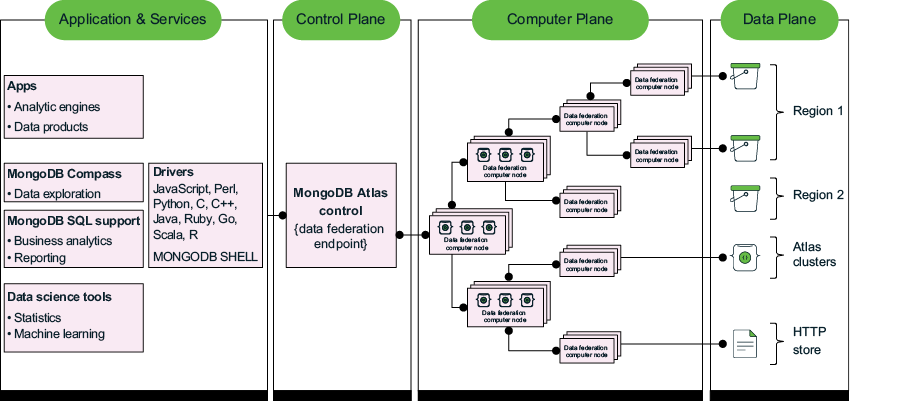
Use the architecture figure to trace requests from applications through orchestration and elastic computation to distributed data sources. section 16.2
