liveBook · Manning

Distribution system port

As explained in Acing the CCNA Exam: Volume 2 Advanced Networking and Security

A distribution system port is a wireless LAN controller network port that connects the controller to the wired distribution system.

A distribution system (DS) port is a physical wireless LAN controller network port that connects the controller to the wired distribution system. It is distinct from a WLC interface, which is a logical entity. section 21.2.1 section 21.4

Key operational facts:

  • DS ports can participate in a link aggregation group (LAG) to provide increased bandwidth and redundancy. section 21.2.1
  • When link aggregation is enabled, all WLC DS ports belong to the LAG by default, although only one functioning physical port is required for operation. section 21.2.1 section 21.4
  • The available port types depend on the WLC model; one example has four DS ports and no service or redundancy ports. section 21.2.1

WLC-to-switch connection

WLC1 connects to SW1 through DS ports 1 and 2, forming the LAG that carries the controller’s distribution-system connectivity. section 21.2.1

Figure 21.9 WLC ports and interfaces. Ports are physical connectors that connect to other devices, and interfaces are logical entities in the WLC.
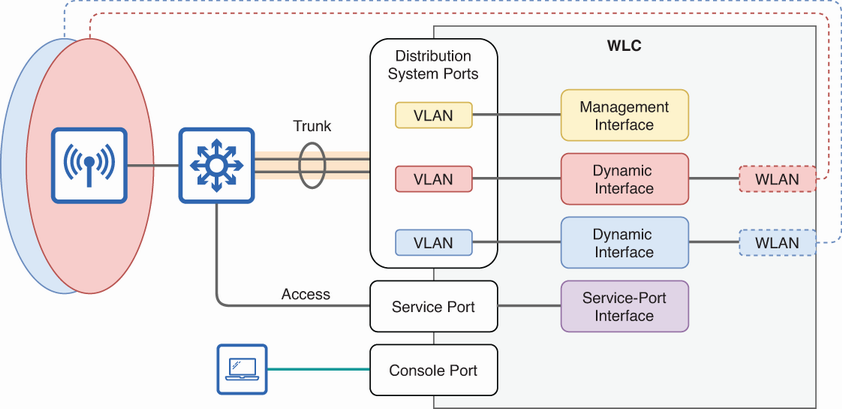
Use the port-and-interface figure to distinguish physical DS ports from logical WLC interfaces. section 21.2.1

How Acing the CCNA Exam: Volume 2 Advanced Networking and Security covers it

How deep it goes
Defines physical-versus-logical terminology and explains LAG behavior, but does not provide command-level configuration or verification.
Examples
Uses WLC1 DS ports 1 and 2 connected to SW1 as a LAG example.
What it assumes
Teaches the physical-port and logical-interface distinction directly, without requiring prior WLC port terminology.
What you can do after
Operate DS-port connectivity and assess whether a WLC LAG remains operational with available physical links.
How it connects
Connects physical ports with wireless LAN controllers, distribution systems, link aggregation, switches, and logical interfaces.

Related concepts

This explainer was generated by Manning's knowledge graph from the text of Acing the CCNA Exam: Volume 2 Advanced Networking and Security. The section links point to the parts of the book it draws on.