Diversity-based sampling selects unlabeled items that are underrepresented or unknown to a model for human annotation. Rare features, unfamiliar inputs, or underrepresented demographics can leave gaps in training data and lead to poor or uneven performance. The aim is to give the model a more complete picture of the problem space. section 1.3.1
Finding gaps in disaster reporting
A disaster-response model trained on news headlines might have only one or two examples of floods, or none describing a new disease outbreak. Sampling for diversity can bring these cases to annotators’ attention. New sources may also introduce unfamiliar language or slang, requiring the training data to adapt. section 4.1.1
Different approaches target different kinds of gaps: section 4.1
- Model-based outlier sampling finds items unfamiliar to the current model. section 4.1
- Cluster-based sampling finds patterns in the data independently of the model, helping include rare but meaningful trends. section 4.1
- Representative sampling targets unlabeled items resembling the domain where the model will be deployed. section 4.1
- Sampling for real-world diversity targets coverage of groups or conditions, such as speakers with different accents, ages, and genders. section 4.1
Diversity sampling complements uncertainty sampling, which selects items near the model’s decision boundary. Uncertain items can be concentrated in one area, while diverse items far from the boundary may have little immediate effect on it. Combining the strategies can select uncertain items from different parts of the problem space. Annotating some random data also provides an accuracy gauge and a baseline for comparison. section 1.3.1
Figure 1.2 Pros and cons of different active learning strategies. Top left: The decision boundary from a machine learning algorithm between items, with some items labeled A and some labeled B. Top right: One possible result from uncertainty sampling. This active learning strategy is effective for selecting unlabeled items near the decision boundary. These items are the most likely to be wrongly predicted, and therefore, the most likely to get a label that moves the decision boundary. If all the uncertainty is in one part of the problem space, however, giving these items labels will not have a broad effect on the model. Bottom left: One possible result of diversity sampling. This active learning strategy is effective for selecting unlabeled items in different parts of the problem space. If the diversity is away from the decision boundary, however, these items are unlikely to be wrongly predicted, so they will not have a large effect on the model when a human gives them a label that is the same as the model predicted. Bottom right: One possible result from combining uncertainty sampling and diversity sampling. When the strategies are combined, items are selected that are near diverse sections of the decision boundary. Therefore, we are optimizing the chance of finding items that are likely to result in a changed decision boundary.
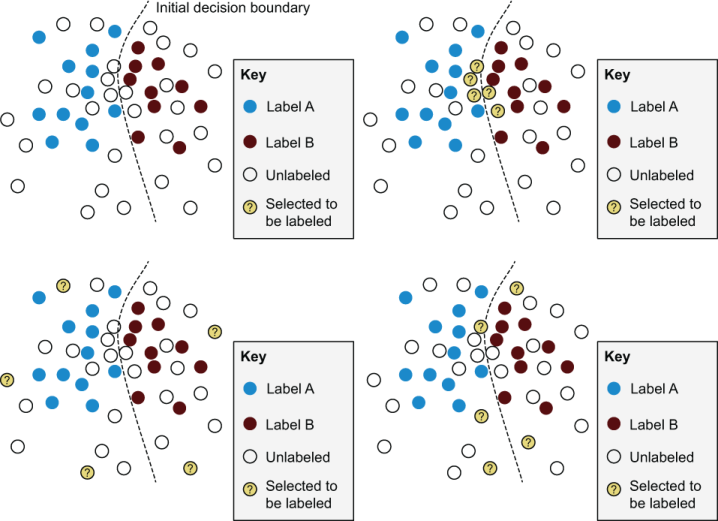
Compare how uncertainty, diversity, and their combination select items relative to a decision boundary. section 1.3.1
Selection must reflect the task. In object detection, diversity in the objects may matter more than diversity in the background, so one option is to crop images to predicted bounding boxes before sampling. Cropping can also discard useful background information; camera type, time of day, and weather may matter when assessing coverage. section 6.1.3
Diverse sampling cannot guarantee a perfect or unbiased model. If the unlabeled pool lacks enough relevant examples, annotation alone cannot fill the gap. Measuring performance across demographics can help reveal potential biases. section 4.5.5 section 4.9