A document database stores complex, nested records in formats such as JSON or XML. Its schemaless structure can change over time, making it suitable for semistructured information that does not fit neatly into tables. section 11.2.2 section 11.5
Use document databases when data has varied or evolving properties, such as:
- Early-stage IoT data whose format is still changing. section 11.2.2
- Audio and video content with diverse properties. section 11.2.2
- Uploaded employment-verification documents. section 11.2.2
- Semistructured application logs used for performance monitoring. section 11.2.2
Document databases often use NoSQL to query key-value pairs, so analysts may need a specialized query language. Nested JSON also requires transformation into tabular data for analysis, while changing structures require quality checks such as null-record and schema-change checks. section 11.2.2
Figure 11.7 An example of a document structure in JSON that may exist in a document database.
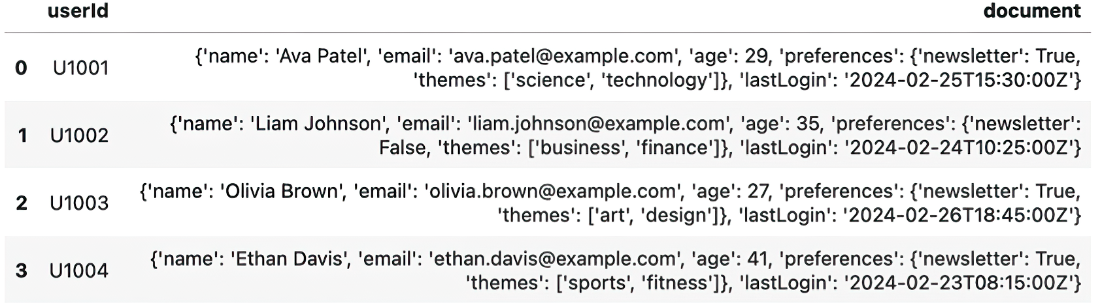
A JSON example makes the nested document structure visible and clarifies why later tabular transformation may be necessary. section 11.2.2


