A document-oriented data model stores records as self-contained documents, allowing flexible fields and nested information. MongoDB uses this structure to support varied applications and efficient distribution across servers. section 1.0 section 1.2
The model is especially useful when applications must scale beyond a single server:
- Self-contained documents reduce dependence on complex joins common in relational databases. section 1.2
- MongoDB can distribute documents across shards, route queries to the appropriate server, and rebalance data as machines are added. section 1.2
- Scaling out adds machines and capacity, while scaling up remains constrained by server cost and physical limits; scaling out also increases management complexity. section 1.2
Application fit
A high-volume application can keep related information together in documents and distribute those documents across a sharded cluster. MongoDB applies the same broader platform to use cases such as faster e-commerce lookups, chat range queries, analytics dashboards, real-time stock updates, and geospatial mapping. section 1.0 section 1.2
Figure 1.1 MongoDB’s sharding architecture enables horizontal scaling by distributing data across multiple servers. (Image © MongoDB 2024 CC BY-NC-SA 3.0)
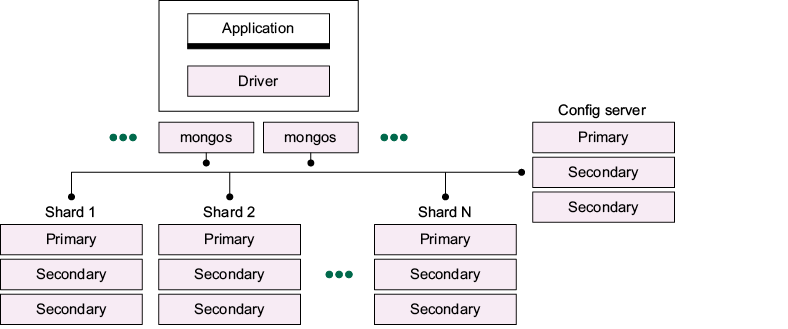
Use the architecture diagram to trace how applications and drivers reach query routers, shards, and the distributed data layer. section 1.2
